411 SEO for Small Businesses: Google Rankings, AI Search, and Getting Found Online with Matt Diamante

411 SEO for Small Businesses: Google Rankings, AI Search, and Getting Found Online with Matt Diamante
Episode 411: Rain or Shine Podcast
Guest: Matt Diamante, founder of Hey Tony Agency
Stop Being Invisible Online: The Simple SEO Foundation That Puts Small Businesses on the Map
Episode 411: Rain or Shine Podcast
Guest: Matt Diamante, founder of Hey Tony Agency
Quick Summary
Matt Diamante — founder of the Hey Tony Agency — joins host Kelsey for a candid conversation about his winding path from process server to band member to SEO expert. Matt breaks down the foundational steps any small business owner can take to rank on Google, explains how AI search is changing content strategy, and shares the simple daily habit that transformed his referral-only agency into a content-driven machine.
In This Episode
How Matt accidentally fell into marketing while trying to promote his band
The unusual jobs (process server, film crew) that shaped how he runs his agency
Growing an alternative lifestyle blog from zero to 4 million monthly visitors — and what it taught him about hooks
The origin story behind the name "Hey Tony"
The three SEO fundamentals every small business needs: Google Business Profile, a multi-page website, and topical authority
Why most SEO vendors are scamming small businesses — and how to protect yourself
The AI prompt Matt uses to write unique, expert-driven blog posts in one hour
How SEO is evolving in the age of ChatGPT and AI search engines
What two books pushed Matt to post on social media every single day in 2023
Why he doesn't batch content — and why he thinks you shouldn't either
Watch The Youtube Video
Key Takeaways
Every page on your website is a door. Service-based businesses should have a dedicated page for every service they offer. If Google doesn't see it, it doesn't know you offer it.
Use AI to extract your expertise, not replace it. Instead of asking ChatGPT to "write a blog post," prompt it to interview you with 10 questions and answer in voice mode. The result is genuinely unique content that reflects your experience.
Get to the point faster. In the age of AI search, content that buries the answer under a long preamble will lose. Lead with the answer, then go deeper.
Reviews require a system, not willpower. Build a consistent ask into every completed transaction. You can incentivize leaving a review — just not a five-star one specifically.
Consistency beats perfection. Matt went from 4 hours per video to 5–10 minutes by posting every single day. The skill builds. The ideas flow. Just start.
Memorable Quotes
"I believe the world is built on small businesses. If I can help good people grow through SEO, they can hire more staff, create jobs, send their kids to college. If I want to make the world a better place, I can do that one small business at a time." — Matt Diamante
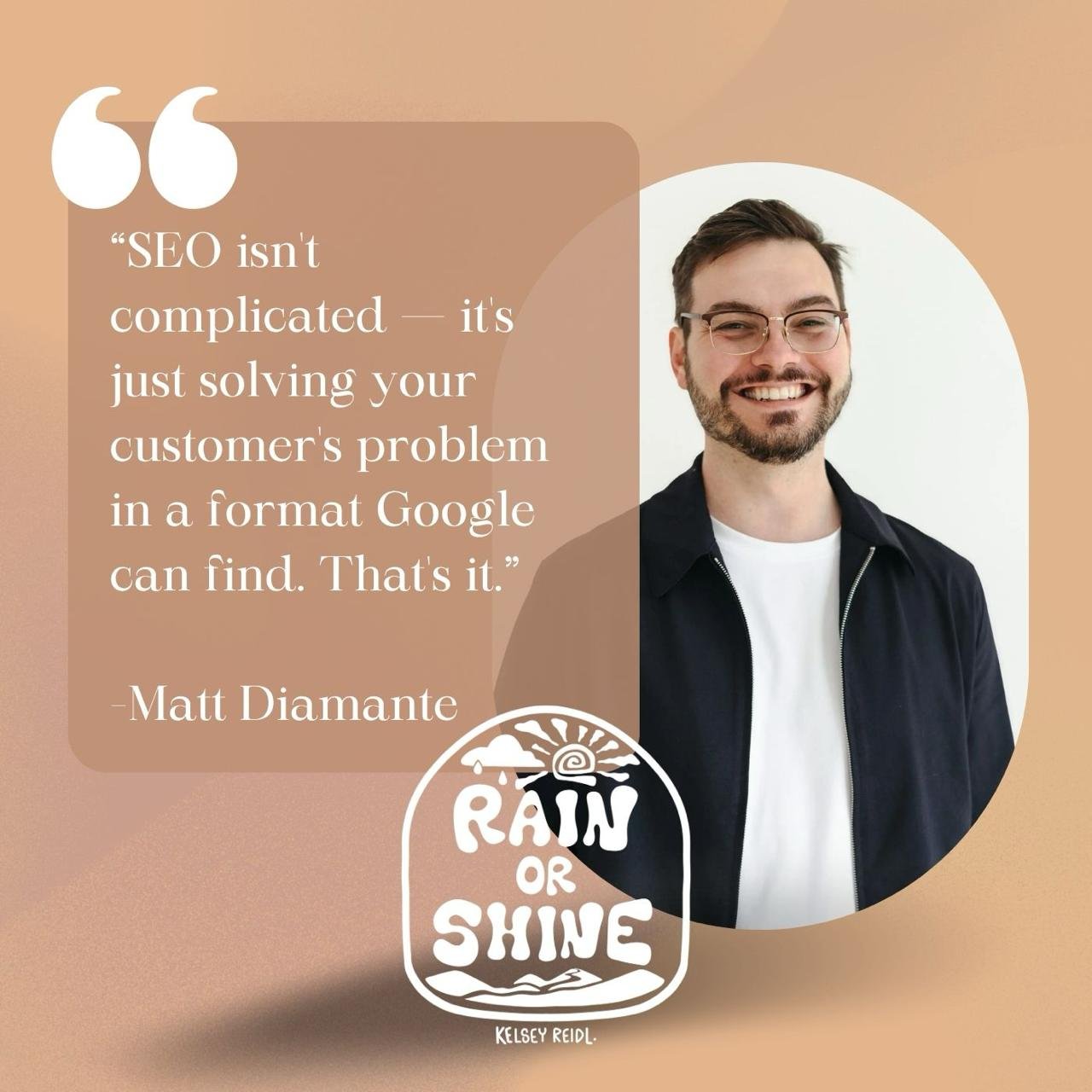
"SEO is just solving somebody's problem. How do I fix this myself? That's a blog post. How do I hire someone? That's a service page." — Matt Diamante
"That's basically how you run a business. You set up a printer in your car and you figure out how to do this more efficiently." — Matt Diamante
Resources Mentioned
Kelsey’s Website: KelseyReidl.com
Kelsey’s Instagram: @KelseyReidl
Instagram: @heytony.agency
Get Found by Matt Diamante — Matt's plain-English SEO book for small business owners
The One Thing by Gary Keller & Jay Papasan
Jab, Jab, Jab, Right Hook by Gary Vaynerchuk
AnswerThePublic.com — tool for finding customer questions to write blog posts around
ChatGPT / Claude — recommended AI tools for blog post creation
Hey Tony Inside — Matt's community for small business owners doing their own SEO
Google Business Profile — free local SEO tool for any brick-and-mortar or service-area business
About the Host
Matt Diamante is the founder of Hey Tony Agency, a Canadian digital marketing agency specializing in SEO for small businesses. After growing an alternative lifestyle publication to 4 million monthly visitors, Matt channelled those hard-won content lessons into building an agency, a community, and a book — all aimed at helping small business owners get found online without getting scammed. He has posted on social media every single day since January 2023.
-
DELIVERABLE 1: CLEANED & EDITED TRANSCRIPT
Kelsey: Matt, welcome to the Rain or Shine podcast! I was just saying before we started recording that I've actually been following you on Instagram for many years. I've known of your agency, but never really got to know where you live or where the business was based. I was pleasantly surprised to find out that you are a fellow Canadian entrepreneur, and I'm really excited to dig into how you got into this, where you're at today, and to pick your brain — because my audience knows I'm very passionate about search engine optimization.
And now, how do we get our businesses to show up in AI engines? I think it's this mystical, complex world that you are really good at simplifying. So officially, welcome to the show.
Matt: Oh my God, thank you for having me. I'm very excited to chat. Your energy is just so good.
Kelsey: I love podcasting and I'm a very curious person. So let's get into the first set of questions — these are always rapid fire, just for fun. As an agency owner, I imagine you have busy weeks and lots of clients. How do you like to unwind at the end of a long week?
Matt: I like a nice glass of red wine. And actually, because of everything that's happening in the US, I've been trying a lot more local wines — and I'm surprised, like, wow, these things are actually so good.
Kelsey: Isn't it fun? We have so many wineries. I live in the Brant County, Norfolk area and there's actually a lot of wineries and breweries within an hour to two-hour distance. So I'm like, why am I going to buy a California bottle when there's literally good stuff right here?
Matt: I think we just have it in our heads sometimes that it's not as good if it's made in Ontario — but I actually think it's better. I moved last year to the Niagara region and there are like a hundred wineries. Every couple of weeks we go to another one, have a glass of wine and try it. It's amazing.
Kelsey: What is one of the most unexpected or unusual jobs you ever had before you started Hey Tony Agency?
Matt: So before I even got into marketing, I was a process server. A process server is where you go and deliver court documents to people — not necessarily people who are avoiding them, but like, you're getting divorced or you haven't paid your child support — and I was the third party who would confirm that person received their legal documents.
Kelsey: That is so interesting! I'm a big believer — and over the past 400 episodes of this show, we've often talked about how our past careers actually teach us lessons we bring into our current path. Did you learn anything from being a process server that has stuck with you?
Matt: I think so. Nobody's ever asked me that. Back in the early days — not really the crazy wifi days — I got scrappy. I was delivering documents to an office an hour away and I didn't have time to stop at home to print things. So I set up my car with an inverter, a printer, and a laptop. I basically hacked this whole thing together. And I'm like, that's basically how you run a business. You're always asking yourself: how can I figure out how to do this more efficiently?
Kelsey: That's a mic-drop moment. If you're not asking yourself that question, you're probably not going to continually advance. You have to get more efficient, offload, delegate, and be scrappy. So how did you get into marketing in the first place? What was that catalyst?
Matt: It was kind of an accident. I went to college for heating and cooling, dropped out after the first year because I couldn't see myself doing it for 30 or 40 years. Took a year off, started a band — and while I was in that band, my parents pushed me to go back to school. I didn't want to go, but I decided to choose a program that would benefit the band. That was advertising. But when I was actually in school for it, I was like, "Oh, I actually really like this. It's a whole other creative outlet."
Even when I was in the band, I was always trying to figure out how to start my own business and make my own money — which is ironic, because now I'm running an agency and technically working for a bunch of different clients. When I was in college for advertising, I really fell in love with SEO, web development, and social media, and I just went full force into that.
Kelsey: Are you still in the band?
Matt: No. There's a guitar back here, but it's got dust on it. I haven't picked it up in probably six months.
Kelsey: So what did you do when you graduated? Did you immediately launch Hey Tony, or did you go freelance first?
Matt: Between my second and third year — it was a three-year program — I interned for one of my professors who had a company doing SEO and social media. While I was doing that, I got a couple of clients on the side myself, so I was kind of freelancing while still in school. These were minor clients — a $500 or $1,000 one-time project. At the time I thought, "Wow, I'm basically getting away with murder — I'm not creating anything physical, I just built them a website." But looking back, those people got so much benefit from that $500.
After college, I moved to Toronto and got an unpaid internship at Shaw Media for a month. During that time I was hustling to find something else and secured a paid internship at an agency. After four months, I realized I hated working at a bigger agency, so I quit advertising altogether and went to work in film — driving trucks, being on set. I still had clients on the side, so I'd be hotspotting from my phone working on client stuff during downtime.
That eventually faded because film work is so sporadic — I couldn't reliably pay bills. So I leaned more into freelancing and tried to grow my client base. But I'm actually skipping a big part of the story.
I started an online publication — an alternative lifestyle magazine, basically a blog that was anti-nine-to-five. We grew it from literally zero to 4 million visitors a month, organically.
Kelsey: 4 million a month?! So you were basically practicing all these marketing strategies on your own publication.
Matt: Exactly. So we got investors — not like a check for a hundred grand, but more of a "we'll see how this goes and as it grows, you'll get shares in the company" kind of arrangement. At three or four months in, they were like, "30,000 views a month isn't a lot — we need more, and we need money coming in."
Then over the holidays, one piece of content went viral. Most websites aren't prepared for that kind of traffic, so the server crashed. We had ads set up improperly. We had to figure all of it out on the fly. Because of the traffic volume, we got approached by Google Plus — and when you signed up for an account, we were one of the featured profiles, which gave us a ton of followers. Then Vice reached out to sell our ads and be part of their ad network. At our peak, we were making $30,000 to $40,000 a month — but we were spending $20,000 to $30,000 a month producing content. This was pre-AI, so we had a larger team outputting six to ten pieces of content per day.
Eventually the publication fizzled. Some of the early people left, the investors got tired of the 120-day payment delays from ad networks, and we decided it wasn't worth pursuing further. But the lessons I took from that experience — especially around hooks, curiosity gaps, and what makes content go viral — I carried directly into my social media strategy when I started posting in 2023.
Kelsey: Where did the name "Hey Tony" come from? That's not your name, right?
Matt: Right — my name is Matt. When I was running that publication, I was walking to lunch one day and overheard some construction workers changing over the streetcar tracks — really rugged, burly guys. And one of them said to another, "Hey Tony, you always know how to put a smile on my face." I just thought, what a genuine expression of emotion from somebody you wouldn't expect. And I was like, that's the kind of feeling I want anyone who interacts with this agency to have. Let's be transparent, let's put smiles on each other's faces.
Kelsey: That is such a cool story. So what were the early days of running the agency like?
Matt: It was slow — not just the first few months, but the first few years. I had built a reputation with clients and friends, and they would just randomly refer people to me. That's not a great way to run a business because you might have ten clients one month or two the next. And figuring out what services to offer, which ones were losing money, which were profitable — all of that took time.
My business plan was pretty simple: make money. There was no advertising budget, no formal strategy. It was just, let me figure out how I can get more people paying me more money.
What I found was that some clients would pay us $50,000 to build a website for a private school — which sounds great, but was a whole hassle. On the other side, someone would pay $2,000 a month for SEO for a dental practice. That's way easier work — there's no urgency, their SEO isn't breaking, we're not monitoring ad spend over the weekend. I was like, SEO is the golden thing. Let's do more of that.
Kelsey: Can you break down why you're so passionate about SEO, and why it's so important for businesses?
Matt: I'm very vocal about SEO and showing people how to do it themselves because a big part of this industry — I'd say most of it — involves people scamming businesses. Business owners know they need SEO, they get a cold email saying "we can help," and then whoever they hire never sends reports, doesn't do anything, or gets them spammy backlinks. Business owners don't know because their skill is in something else entirely.
But the deeper reason I love helping businesses with SEO is because I believe the world is built on small businesses. If I can help good people grow through SEO, they can hire more staff, create jobs, send their kids to college, and pour money back into their local economies. If I want to make the world a better place, I can do that one small business at a time.
Kelsey: What are some of those foundational items someone needs to have in place to begin ranking on a search engine?
Matt: There are a few foundational things. First, if you're a local business, have a Google Business Profile — that's your calling card. It's what shows you on the map, where people can leave reviews, and it establishes your legitimacy.
Second, you need a website. You can't just rely on a Google Business Profile, an Etsy shop, or social media. You don't own those platforms — you're subject to whatever their algorithms decide. With your own website, you own and control the content.
Third — and this is where most people underinvest — you need topical authority. That means creating content that demonstrates you're an expert in your niche. The easiest way to do this is by writing blog posts that answer your customers' most common questions. If you hear a question more than once, write it down. When you have a break, open your website and answer that question in a 500 to 1,000-word blog post. Publish it. Next time someone asks you that question, you can point them to it.
Kelsey: Let's double-tap on Google reviews. A lot of people know they should collect them, but it feels hard to get customers to actually leave one.
Matt: You need to get reviews — full stop. If you're finding it hard, the answer isn't to stop asking. It's to build a system that reminds you to ask every time. When a transaction is complete and the customer is happy, ask them. You can say, "If you leave us a review, next time you come in we'll give you 10% off." You can't ask for a five-star review specifically, but you can incentivize the act of leaving one. It's simple — just ask. Stop being afraid to ask.
Kelsey: And what should a website actually include if you want to rank on search engines?
Matt: If you're a service-based business — say, an electrician — you need a separate page for each service you offer. Panel upgrades, ceiling fan replacements, light fixture installations — each page is a door into your business. The more relevant doors you have, the more ways people can find you. If you're not explicitly talking about a specific service, Google won't know you offer it, and neither will potential customers.
Think of it this way: SEO is just solving somebody's problem. Someone with a roof leak might search "how do I fix this myself" — that's a blog post. They might search "what product do I need to patch it" — that's a product page. Or they might search "how do I hire someone to fix my roof" — that's your service page. Each piece of content is solving a different version of the same problem.
Kelsey: What would you tell someone who starts a blog but then falls off after two posts?
Matt: In my Hey Tony Inside community, the people seeing the most results are the ones who show up to our weekly one-hour work session where we write a blog post together using AI. You can replicate this on your own — just block one hour in your calendar every week.
Here's the prompt I recommend: Go to ChatGPT or Claude and type: "I'm writing a blog post answering this question: [paste your question]. Ask me anything you need to know in order to write a blog post that is truly helpful and unique. It should include my experience, expertise, case studies, examples, and opinions. Keep it limited to 10 questions. Ask me them one at a time because I'll be using voice mode to answer them."
This way, the AI is pulling your expertise and experience out of you through conversation, rather than just generating generic content from the internet. Your ideas go in, AI helps structure and write it out. That's your unique content.
Kelsey: And how is SEO evolving now that AI search engines are becoming more prominent?
Matt: It's more of the same, but with one key shift: get to the point faster. You know how recipe websites have that massive preamble before the actual recipe? That's what we need to eliminate from our content now. If someone asks "how much does X service cost?" — answer that immediately, in the first sentence. Stop burying the answer under an intro paragraph with statistics and linked studies. People have so much information thrown at them. Give them the answer upfront, and then you can go deeper from there.
Kelsey: Let's talk about what inspired you to start posting on social media. You mentioned Gary V — can you take us back to that moment?
Matt: This goes back to January 2023. Up until that point, I was a referral-only business — I couldn't really predict month to month what things would look like. I started reading a lot of business books. I read The One Thing, which is about identifying one action you can do every single day that moves you toward your one-year, five-year, or ten-year goal. Then I read Gary V's Jab, Jab, Jab, Right Hook, which is all about social media and how posting consistently every day can build a following and a more sustainable business.
I put those two ideas together: posting on social media every day was the "one thing" I could do. Up until that point, I hadn't even been on social media personally for five, six, seven years. I was working on Facebook for big brands and hated it. When I joined Instagram in 2023, I was like, "What is this Reels thing? What happened to IGTV?" My wife was like, "Where have you been? You work in marketing."
I gave myself one year. I said: I'm either going to prove these guys right or prove them wrong. I'll post every single day and see what happens. And now it drives everything — the agency, my email list, my book, my community.
Kelsey: How do you come up with content ideas every single day?
Matt: It seems harder than it actually is. When I first started, it would take me four hours to make a 30-second video. Now I can go from having no idea to a finished, posted video in five to ten minutes. Ideas come from conversations like this one, from something a team member tried that worked, from seeing another creator post about something and thinking "that applies to SEO too," or just from paying attention. You have to be looking for stuff. And once you start, your brain just starts thinking in content ideas naturally — it's a muscle.
I don't batch my content. A lot of people suggest spending a day or two filming everything for the month. But if your first video goes viral, the rest of the batch probably won't replicate that. You lose the ability to iterate in real time. When you post daily, you can see what works and adjust the very next day.
Kelsey: Where can people connect with you and learn more?
Matt: Just type in Matt Diamante or Hey Tony on any social network — I'm there posting every single day. I also wrote a book called Get Found, which takes you from knowing nothing about SEO to having a real strategy, written in plain English. And I have the Hey Tony Inside community for business owners who want to do SEO themselves with some guidance and accountability.
Kelsey: Matt, thank you so much for sharing your story on the Rain or Shine podcast. We really appreciate you and encourage everyone to go check out your work.
Matt: Thank you so much for having me.

Book Your Free Marketing Strategy Call
Your business deserves to be found—both on Google and ChatGPT.
If you're a solopreneur, author, or thought leader wondering why your marketing isn't translating to consistent revenue, the problem usually isn't what you think.
After 8+ years of working with ambitious entrepreneurs, I've discovered something crucial: most marketing challenges aren't about needing more tactics—they're about solving the wrong problem.
Here's What We'll Uncover Together:
✓ The Real Constraint blocking your growth (it's rarely what you think)
✓ Your SEO Opportunity to rank on Google for what matters
✓ Your AI Visibility Gap and how to show up when prospects ask ChatGPT
✓ Your Lead Generation Blind Spots and where you're losing potential clients
✓ Your Custom Funnel Analysis showing exactly where the leaks are
Book now!
The Potential Return: A clear path to $10K-$50K+ in new revenue
I work with business owners who are done guessing and ready for a marketing strategy built on what actually works—not marketing myths.