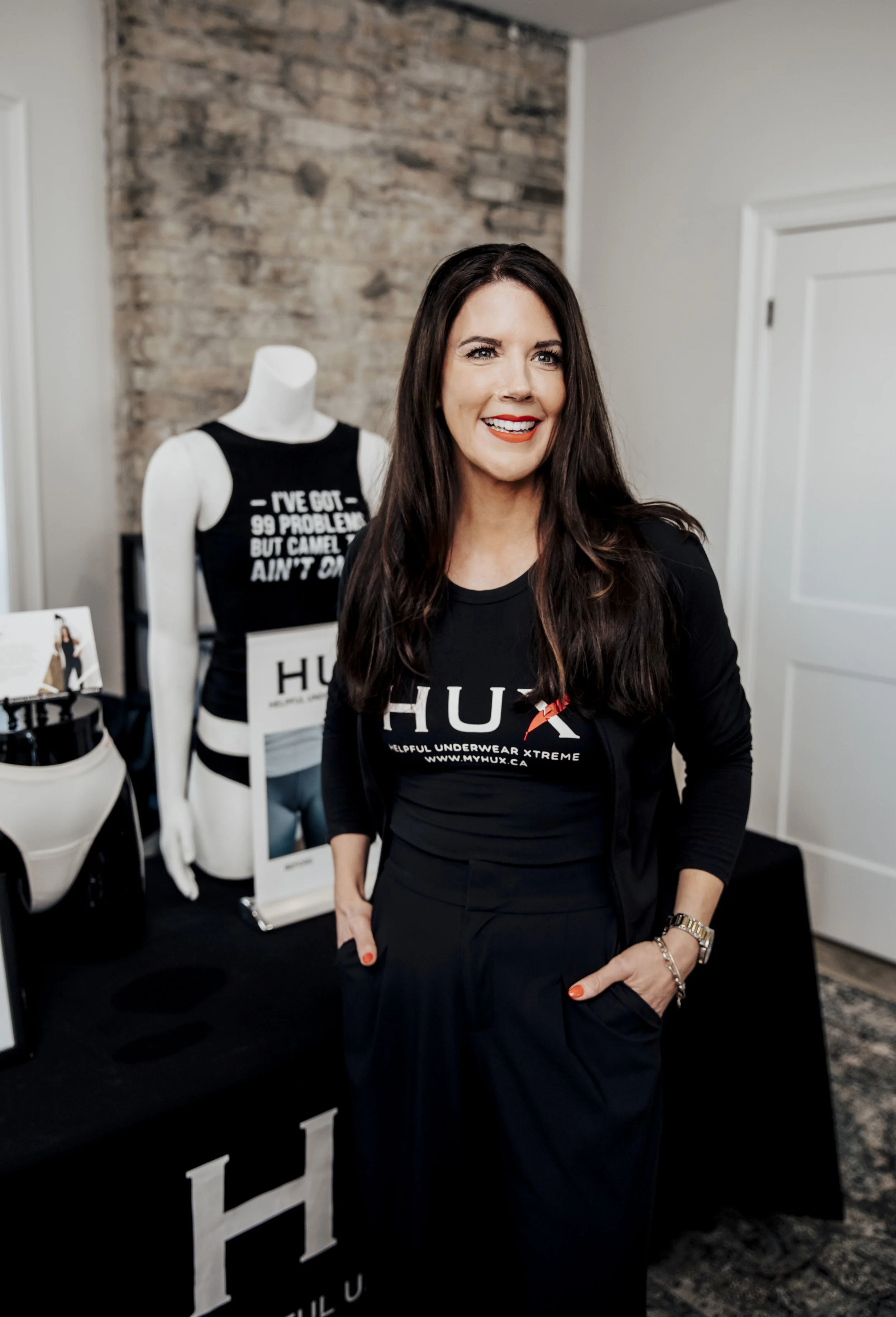
415 How Jen Govier Built HUX: From Gym Embarrassment to a Global Underwear Brand in 19 Countries
415 How Jen Govier Built HUX: From Gym Embarrassment to a Global Underwear Brand in 19 Countries
Episode 415: Rain or Shine Podcast
Guest: Jen Govier, Founder of HUX Underwear
From Camel Toe at the Gym to 19 Countries: How Jen Govier Built HUX
Episode 415: Rain or Shine Podcast
Guest: Jen Govier, Founder of HUX Underwear
Quick Summary
Jen Govier is the founder of HUX, a bamboo charcoal underwear brand designed to eliminate camel toe and keep women feeling confident and comfortable. In this conversation, Jen shares the origin story behind HUX — from a mortifying gym mirror moment to a product now sold in 19 countries — and the patient, intentional entrepreneurial journey that made it possible.
In This Episode:
The gym mirror moment that sparked the idea for HUX
Why Jen spent four years validating and building before launching in 2020
How she balanced building a business on evenings and weekends while running private wealth management
The decision to resign from a six-figure corporate career at 50 — and what happened immediately after
How organic social media and community-first marketing drove 90% of HUX's growth
The shift from saying yes to everything to being strategic with time and ROI
Landing GoodLife, F45, The Source, and Trish Stratus — and what made those partnerships work
Manifestation as a practice: dreaming bigger and taking action despite not knowing the "how"
Watch The YouTube Video
Key Takeaways:
One thing a day compounds. Jen turned a gym mishap into a global brand by committing to a single daily action — starting in 2016 and launching in 2020. Time passes anyway; put it to work.
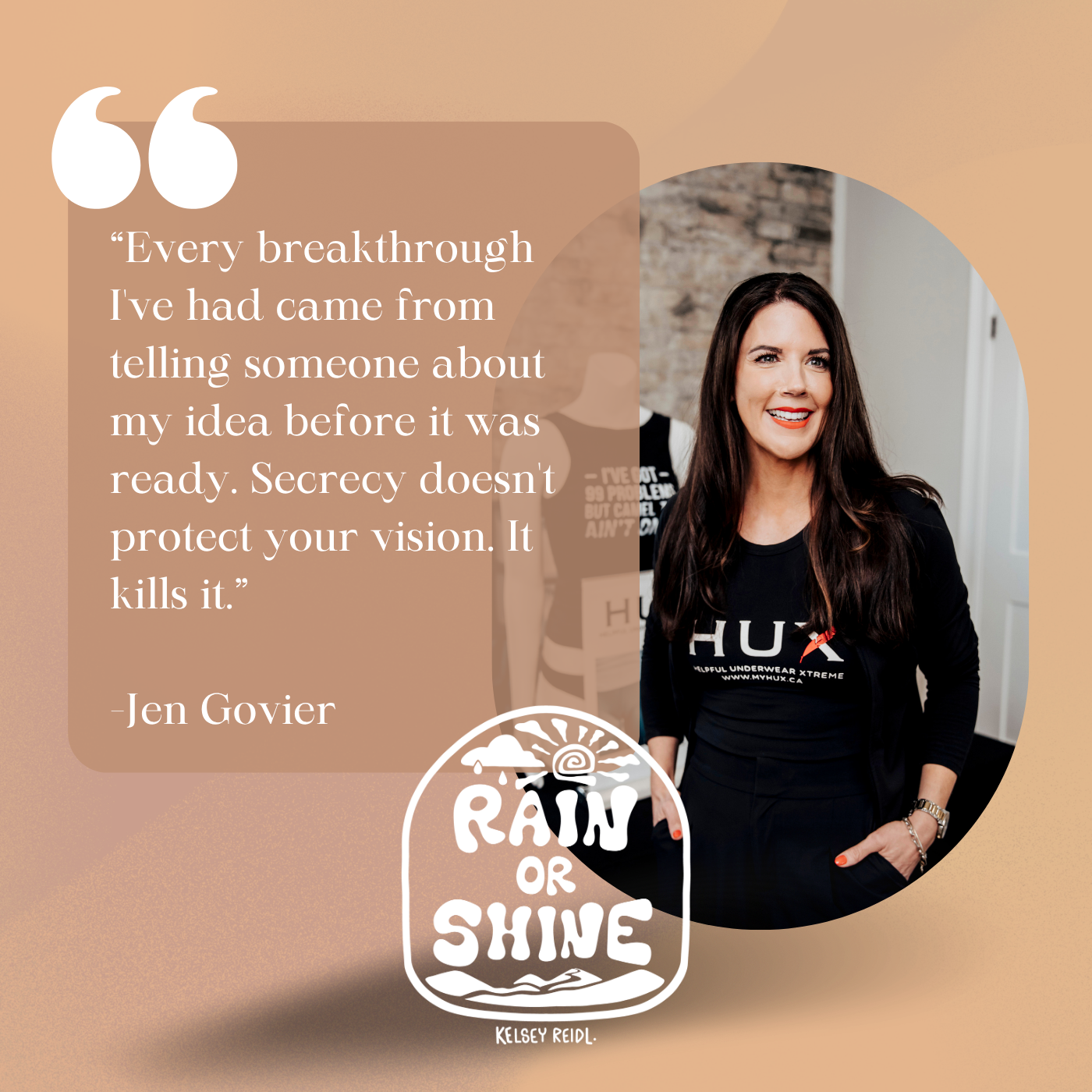
Talk about your idea before it's ready. Every major breakthrough — the fashion mentor in Costa Rica, the GoodLife connection, Trish Stratus — came through people who knew what she was building. Keeping an idea private kills the serendipity.
Saying yes to everything has a shelf life. Early-stage, saying yes builds brand awareness. Later-stage, it erodes margins and time. Learn when to make the shift.
Partnerships are for credibility; direct-to-consumer is for revenue. Major retail and gym partnerships gave HUX legitimacy — but organic social media and word-of-mouth remains the #1 revenue driver.
Don't wait for a full-body yes before leaping — build toward it. Jen's leap felt right because she spent years preparing the conditions. There's no universal timeline.
Memorable Quotes:
"Time is going to pass anyway — so you might as well put in what you want." — Jen Govier
"The day I resigned, we were on Breakfast Television. Within three months we'd signed with GoodLife. It was like the universe said, 'Okay, you're serious. We'll meet you where you're at.'" — Jen Govier
"It's more than underwear. It's about giving women confidence — whether you're at the gym or on a stage. It's the first thing you put on every day. You want to feel good in it." — Jen Govier
Resources & People Mentioned:
Friends and Neighbors (TV series, starring Jon Hamm) — Jen's current binge
Kelsey's Website: www.KelseyReidl.com
Kelsey's Instagram: @KelseyReidl
GoodLife Fitness — national partnership / rewards program
The Source — Canadian retail partner
F45 — gym partnership
London Health Sciences Centre — employee program partner
Trish Stratus — WWE Hall of Famer, brand ambassador for HUX 2.0 launch
Dragon's Den — Jen pitched producers; validated unit economics without taking a deal
Molly Middleton — Dragon's Den producer
Western University (London, ON) — Engineering department, early fabric research
About the Guest
Jen Govier is a London, Ontario-based entrepreneur and the founder of HUX, an innovative underwear brand built around bamboo charcoal fabric and a built-in camel toe guard. After nearly a decade of building the brand alongside a career in private wealth management, she left a senior banking role in January 2025 to go all in. HUX has now been sold in 19 countries.
-
CLEANED & EDITED TRANSCRIPT
═══════════════════════════════════════════
Kelsey: Jen, welcome to the Rain or Shine podcast. I am so excited to sit down with a fellow Canadian entrepreneur — someone who is so passionate about a topic we've never really chatted about in 450 episodes: underwear and camel toes. We're going to go all over the place today. Thank you so much for being here.
Jen: Thank you, Kelsey, for having me. I'm super excited to be here.
Kelsey: We always start with some rapid fire questions to warm up our guest and let listeners get to know you on a personal level. You're a business owner with a lot going on each week. When you arrive at Friday night and need to wind down after a busy week, what do you do to unwind and de-stress?
Jen: There are a couple of things. If it's summer, we love to sit out back and have a fire. I don't know what it is — it just takes me away and makes me feel like I'm on holiday. My husband and I will go out back, light a fire, and just sit by it and look at the sky. The other thing is I don't watch a ton of TV, but Friday night is the night I'll do it. We're currently bingeing Friends and Neighbors with Jon Hamm. It's unbelievable — this dramatic life that I'd never want to live. It makes you feel good about yourself. I highly recommend it.
Kelsey: You and I have a lot in common, because my favorite Friday night activity is also sitting by the fire with my husband. It's so nourishing and simple, but it recharges the batteries completely. And I've heard so many people talking about Friends and Neighbors — I'm writing that down right now.
Jen: You will be glad you did.
Kelsey: What is one non-negotiable routine you do before you start your work day?
Jen: I have a very intentional morning. I get up before anyone else in the house. I do a guided meditation, I journal — including 10 things I'm grateful for — and I always go to the gym first thing in the morning. I was doing it six days a week; I've cut back to five because my body needs a bit more recovery. But if I don't do that, I feel off. I love vacation, but I also love routine. When I can get all of that done, I feel like I'm living my best life and I'm ready for the day.
Kelsey: I love that so much. There's such a common thread among the entrepreneurs I interview — fitness is a non-negotiable. It's never left to chance, because you know the day can go in so many directions. Taking care of our bodies as the vessel for our business is so important.
Jen: Absolutely. Even mentally — when I dropped from six days to five, I was restless. I'm doing more active recovery now, but that morning routine sets me up so that even if I'm working a 12-hour day, I have the stamina and the energy to do it.
Kelsey: So let's go back to the beginning of HUX. You're at the gym, you catch a glimpse of yourself in the mirror, and you have a moment of embarrassment that many women can relate to. Walk us through that moment — and at what point did you go from "this is annoying" to "I'm going to be the one to solve this"?
Jen: I was at the gym checking my form and I saw my reflection. I saw my camel toe and I was mortified. I didn't know whether to stay or leave. As I talked to other women, they said, "For sure this is a thing — I just wear a long tunic," or "I wear shorts instead of fitted pants." My niece was a cheerleader at the time, and she told me they put sticky inserts in their shorts so that when they get tossed in the air and their skirt goes up, they're not worried about anything showing.
So I put one of these inserts — it was actually a thing that goes in the base of a high heel to keep your foot from slipping — into my workout pants. It was comfortable, it fit, and it did the job. Then I started doing warm-up laps around the gym. The instructor, Wanda, stopped to pick something up off the ground — she didn't want someone to trip on it — not realizing that what she had in her hand had just been in my pants a moment before.
That was literally the genesis of HUX. I thought, "Why isn't this stitched into underwear?" So many women were telling me this was a problem. I was working in finance at the time — nothing related to this world — but enough women were sending me clips of the Kardashians complaining about the same issue, and I thought: "How has nobody solved this?" I committed to doing one thing every day to move the idea forward. Time was going to pass anyway.
Kelsey: I love this story so much. There are so many problems we bump up against as women, but I think it's remarkable that you started that journey with "can I solve this?" — without a grand master plan. Just one thing a day. What were some of those first actions you took to bring the idea to life?
Jen: The first thing I did was validate the idea with close friends and colleagues. One of those colleagues was a man we worked with at one of the top banks in Canada — nothing related to this — and he said, "I actually love this idea. I've heard my wife talk about this." That told me: okay, this is something.
Then it was about research. What fabrics are out there? What products already exist? We ordered everything on the market. There were makeshift inserts, but no underwear that truly had this built in. I went to the engineering department at Western University in London and just started researching — one little thing at a time, while working full-time and raising two young boys, doing this on evenings and weekends.
The idea started in 2016, but we didn't launch until 2020. Most people would have given up. I had a big job — I was traveling to India, running private wealth management — and I just kept doing one little thing. Then my friends went to a spiritual retreat in Costa Rica and met a woman there who happened to be in fashion — she'd had her own line, worked for Nike, appeared on the Home Shopping Channel. For some reason my friends told her about my idea. She flew into Toronto from New York just to meet me. We sat in Sassafras restaurant pulling out a prototype pair of underwear with literal staples in it. But once I was intentional, the right people and the right doors started opening.
Kelsey: I think some people would hear that Costa Rica story and say "she got lucky." But when we're intentional and we speak our vision out loud — even when it's imperfect — we create those serendipitous connections. Had you been building this privately and keeping it close to your chest, that never happens. Did you experience fear around showing people the imperfect side of the business?
Jen: Along the way it didn't bother me as much. But where I was really up against something was the decision to leave my job. I didn't resign until January 2025, even though we launched in 2020. I wanted to ensure proof of concept, recurring revenue, customer testimonials, and manufacturing set up. I had left a very significant role — I was the first woman in that position, running private wealth management offices in multiple cities, earning more than I had ever dreamed of. It was everything I'd wanted as a child.
I had two coaches at the time — a business coach and an executive coach — and both were essentially telling me: "Jen, you don't need more time. You need a deadline. This brand is already global — you've shipped to multiple countries. Just pick a date and jump." I was terrified. My ego was attached to that lifestyle and the income my business wasn't yet matching. People thought I was crazy to leave a sure thing, especially turning 50.
But I'd already sold in 19 countries. So I thought, what does a half-million dollars in deferred compensation matter if I truly believe this is going to be a global brand? I took the leap. The day I resigned, we were on Breakfast Television. Within three months we had signed a national partnership with GoodLife Rewards. It was like the universe said, "Okay, you're serious — we'll meet you where you're at." We doubled our revenue in the first year.
Kelsey: Looking back, do you wish you had gone all in sooner?
Jen: No, I think it happened exactly the way it had to. The majority of clients in private wealth management are entrepreneurs — the wealthiest people in the world. Being in that world showed me what was possible. It gave me an abundance mindset. And eventually my values were being challenged — people were fighting over referrals instead of focusing on helping clients. I needed that contrast to say, "This doesn't align with who I am." Without that, I probably would have stayed.
Kelsey: I think this conversation is so important because there's a dominant narrative of "just leap and the net will appear." But for some people, building trust in the vision — making sure the product-market fit is there — takes three, five, even seven years. That's not failure. That's how it has to grow.
Jen: Exactly. And we were raising two boys in competitive sports. I didn't want to be reckless. My husband and I had fully self-funded the business. But now that I'm all in, I can see that a business like this requires capital to grow. We're actively starting to raise money now. Women are asking for bathing suits with the same gusset. The manufacturing is lined up. I'm ready to pour fuel on this.
Kelsey: You've alluded to big accounts — GoodLife, The Source, F45, Breakfast Television. Let's rewind to when you had your first sellable product. How did you get HUX in front of your first customers?
Jen: It was social media. I wasn't comfortable with it at first — I didn't want to be "that person." I look back at my early content and cringe; I was so self-conscious. But people around me kept saying, "Jen, this isn't about you — it's about getting the product out there." Today we get orders from Singapore and Australia, and when I ask how they found us, the answer is always social media. And we've done barely any paid media in the last year and a half. It's been organic and influencer-driven.
A woman with 750,000 followers posted about a wardrobe malfunction, and women in my community tagged her saying, "You need to try HUX." She reached out to me, I gifted her a package, she posted about it, and that single post drove 90% of the kind of customer momentum we still see today. Even with everything else — GoodLife, F45, The Source — it's still women telling other women. That has been our greatest asset.
Kelsey: That all starts with having a product that genuinely changes lives. And I love how your community rallied and tagged her, and then you took action right away to send the gift. So many people skip paid ads too quickly. There are so many low-cost, low-risk strategies to test first.
Jen: We also did pop-ups — all over the place. A big show in Toronto cost anywhere from $7,000 to $10,000 once you factor in travel, accommodation, and staff. That's a lot of underwear you have to sell to break even. But my girlfriend invited me to a volleyball tournament — 16 teams, girls aged 16 to 18 — in Strathroy, Ontario. I was skeptical. This is a $37 premium product — a teenager isn't going to buy this. We went anyway.
We did better at that tournament than we did in Toronto with 20,000 women. Because these girls were wearing shorts that gave them camel toe, and the moms and dads were lined up to buy. So it was about figuring out where your real customers are and being smart about where you spend your dollars.
Kelsey: You said you had a "say yes to everything" phase. Do you still operate that way?
Jen: Not anymore. That mentality was incredibly helpful early on for building brand awareness. Now we have recurring revenue and I can be more efficient. TikTok is getting real traction — live shopping has essentially no channel cost. It makes much more sense for me to create content than to drive six hours for a pop-up with an uncertain ROI. When someone invites me to something now, I immediately ask: what's the time investment, and what's the return? If it doesn't make sense, I say respectfully no — but I'll often find another way to support them, like donating a prize pack. I'm okay with not being able to do everything.
Kelsey: Let's talk partnerships. GoodLife, F45, The Source — how do you think about partnerships strategically, and what would you say to someone with a product-based business who wants to get into a major retailer?
Jen: For GoodLife, I simply knew it was the right fit. It's a national brand I believed in, and I knew someone who had a connection there — a former GoodLife executive who knew my product, came to my events, and genuinely cared about what I was building. She put me in touch with the gentleman running the partnership program. My product lives in those gyms. Members were already wearing it. It was a natural fit.
That said, I'll be completely honest: it's not my best revenue engine. Direct to consumer is. But partnerships are enormously valuable for credibility. When a brand like GoodLife is associated with you, people trust that there's substance there.
One of my greatest personal achievements was landing Trish Stratus — WWE Hall of Famer, former judge on Canada's Got Talent, one of the biggest names in women's empowerment in sport. I pursued her for four years before she agreed to help us launch our 2.0 collection. I first connected through a coach who happened to know her manager. I shipped her the product, heard nothing for a year and a half, but kept genuinely engaging with her on social media — not just liking posts, but commenting because I truly admired her work. I'd periodically send a note asking if she'd received the package.
Then I posted a before-and-after camel toe graphic, and she replied: "This is brilliant." That opened the door. She put me in touch with her team, things stalled, I reached out again. Most people would have given up. I didn't. We eventually met for breakfast in Toronto, worked out a deal, and she helped us launch our 2.0 collection. She told me, "People pitch me all the time. I went through your Instagram, I love your energy." That meant everything.
Kelsey: You're very passionate about manifestation. Looking at that whole Trish Stratus storyline — was that manifestation, or manifestation paired with action?
Jen: It's always both. I've studied manifestation since I was a child. I'm one of ten kids, and we didn't have a lot growing up. My dad always had a second job — he was a landscaper on the side — and I would go with him to these properties in the evenings. I'd wander around, look through the windows, and tell myself, "This is the life I want." Even as an eight or ten-year-old, I knew it was possible for me. I always dreamed a bigger dream.
In my life, the synchronicities have been undeniable. Jobs I'd think about would come to me. Doors I'd visualize would open. But you have to take action. What holds most people back is worrying about the how. If I had stopped to think, "I work in finance, I don't know anything about apparel — how is this going to happen?" — I would have paralyzed myself. A business plan would have done the same thing. I could see all the work it would take, and it would have been overwhelming.
So I just moved. I had a strong bias for action — every performance review I ever got said that. I don't care if it's not perfect. Let me go, iterate, and move. Where others are still thinking, I've already taken four steps forward.
Kelsey: For any listener who wants to get a pair of HUX — who is it for, and where do they find you?
Jen: HUX is for anyone who wants to feel confident and not worry about what's going on underneath. It prevents camel toe with a built-in buffer, and it's made from bamboo charcoal, so it keeps you dry and fresh. We started in the gym world — athletes love it — but we've found that nurses love it too, because they're on their feet for 12-hour shifts and want that comfort and freshness. We've actually partnered with London Health Sciences Centre because of nurse demand.
So really, it's for anyone who wants to feel comfortable, confident, and dry — whether you're at the gym, in uniform, or on a stage. You can order online at myhux.ca or find us on Instagram at @huxwear. Join our community too — we've built this brand by partnering with other women, and it's the law of reciprocity in action. That's how we've reached 19 countries with almost no marketing spend.
Kelsey: Amen to all of that. This has been one of my favorite conversations in a long time. Thank you, Jen — so much gold, so much wisdom, and so much passion. I can't wait to go get my first pair of HUX. Listeners, go grab yours too!
Jen: Thank you so much, Kelsey. I really appreciate the opportunity.

Book Your Free Marketing Strategy Call
Your business deserves to be found—both on Google and ChatGPT.
If you're a solopreneur, author, or thought leader wondering why your marketing isn't translating to consistent revenue, the problem usually isn't what you think.
After 8+ years of working with ambitious entrepreneurs, I've discovered something crucial: most marketing challenges aren't about needing more tactics—they're about solving the wrong problem.
Here's What We'll Uncover Together:
✓ The Real Constraint blocking your growth (it's rarely what you think)
✓ Your SEO Opportunity to rank on Google for what matters
✓ Your AI Visibility Gap and how to show up when prospects ask ChatGPT
✓ Your Lead Generation Blind Spots and where you're losing potential clients
✓ Your Custom Funnel Analysis showing exactly where the leaks are
Book now!
The Potential Return: A clear path to $10K-$50K+ in new revenue
I work with business owners who are done guessing and ready for a marketing strategy built on what actually works—not marketing myths.