409 From Café Owner to Lawyer at 40: Sonya Szabo on Reinvention, Visioning, and Building a Business on Your Own Terms

409 From Café Owner to Lawyer at 40: Sonya Szabo on Reinvention, Visioning, and Building a Business on Your Own Terms
Episode 409: Rain or Shine Podcast
Guest: Sonya Szabo, Canadian business lawyer and the founder of Zābo Law
How to Stop Drifting and Start Deciding: The Vision Framework That Changed Everything for This Entrepreneur-Turned-Lawyer
Episode 409: Rain or Shine Podcast
Guest: Sonya Szabo, Canadian business lawyer and the founder of Zābo Law
Quick Summary
Sonya Szabo is a Canadian business lawyer, former café owner, and entrepreneur who has never done things the conventional way — and that's exactly why it works. In this episode, she returns to the Rain or Shine podcast after eight years to share the full arc of her story: building and selling the Vic Café, going to law school at forty, battling imposter syndrome, and ultimately creating a law practice that reflects her values instead of the industry mold.
In This Episode
How Sonya opened the Vic Café at 35 with three kids — and led with boundaries from day one. Why she hired a manager before opening the doors. The highs and hard realities of running a brick-and-mortar restaurant for eight years. Going back to law school at forty and navigating four years of imposter syndrome. The "90-year-old self" exercise Sonya uses to make every major decision. Her "quit week" in 2025 — what triggered it and what brought her back. Why in-person relationship-building has been her most effective marketing strategy. What Zābo Law does and how to work with Sonya
Key Takeaways
Know your priorities before you open your doors. Sonya put a note in her very first employee handbook that said she was a mom first — and that transparency set the tone for every working relationship that followed.
Build the business around your strengths, not your job description. She hired a manager before opening and stayed focused on owner-level decisions from the start.
Your vision isn't a prediction — it's a decision-making filter. Sonya doesn't hold her vision because she expects it to happen exactly as planned; she holds it because it tells her what to say yes and no to.
Think about your ninety-year-old self. When you filter decisions through who you want to be at the end of your life, the noise clears fast.
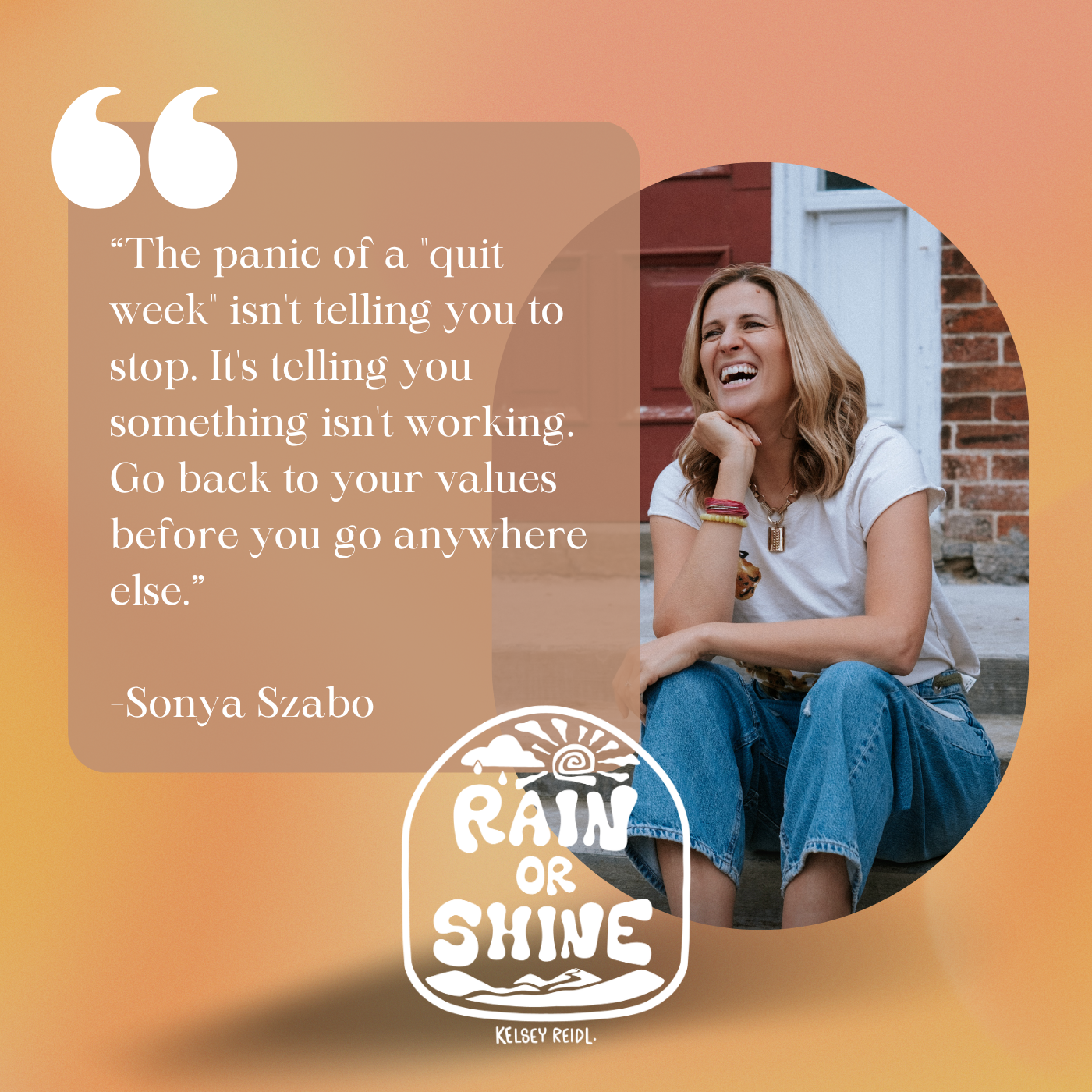
A "quit week" isn't the end — it's a signal. Panic means something isn't working. Go back to your values before you go anywhere else.
Watch The YouTube Video:
Memorable Quotes
"Before we even opened our doors, we hired a manager. Traditionally that would have been the owner's job — but I knew I needed to outsource that and just be the owner."
"When I hold a decision up against my vision and ask, 'Will this bring me closer to where I want to go?' — the answer tells me whether to say yes or no."
"When people started connecting me and 'lawyer' together, you could see the relief on their faces — like, finally, a lawyer who doesn't make me feel belittled. Someone who makes me feel empowered."
Resources Mentioned
The 7 Habits of Highly Effective People by Stephen R. Covey
The E-Myth by Michael E. Gerber (referenced)
Sonya's Instagram: @askmeaboutcontracts
Sonya's Website: sonyaszabo.com
Kelsey’s Website: KelseyReidl.com
Kelsey’s Instagram: @KelseyReidl
Voxer app —walkie-talkie voice messaging
About Sonya Szabo
Sonya Szabo is a Canadian business lawyer and the founder of Zābo Law, where she helps entrepreneurs and business owners navigate contracts, corporate structure, trademarks, and more — in language they can actually understand. After eight years running the Vic Café in Prince Edward County and selling it in 2023, Sonya went to law school at forty and built a practice rooted in her own experience as a founder, parent, and entrepreneur.
-
CLEANED & EDITED TRANSCRIPT
Kelsey: Sonya, welcome back to the Rain or Shine podcast. The last time you were here was over eight years ago — which is absolutely crazy. I'm going to pull that episode and link it in the show notes, because I think it'll be fun for you and me, and for some of our OG listeners who've been here since day one, to go back into the archives and listen.
But today you're back. You have a whole new story to share — eight years to catch up on. So first off, welcome to the show, and thank you for being here.
Sonya: I can't believe it's been eight years. Thank you so much for having me again. It's long overdue. And for the listener — Kelsey and I do get to catch up all the time, so this isn't the first time we've spoken in eight years, but it is the first time I'm back on the mic.
Kelsey: So let's kick off with some rapid fire questions, because I love picking another entrepreneur's brain and hearing some good tips and tricks to ease us into the show. First off, I know you're a busy woman — you work, you have kids, you have a husband who also runs a business. When you get to the end of a long week and you need to unwind, what do you do to give your brain a rest?
Sonya: To me, the best luxury in the world is being able to cook. A really good recipe, a podcast in my headphones, and lots of vegetables — that means I'm relaxed.
Kelsey: There is nothing better. I love that too. The winter always gets me reinspired in the kitchen — baking, cooking, being creative. It's such a simple pleasure. It keeps your hands busy, and you feel so proud of the end result. You feel good feeding others healthy food.
And honestly, I think the high-level entrepreneur advice would be to outsource everything you don't need to be doing — but I would never outsource cooking. That is a pleasure in my life.
Sonya: I learned so much from cooking. There are so many life lessons you can extract from it.
Kelsey: I know you're a fan of many business books. Besides The E-Myth — which I'll cover later in this episode — what is one business, personal growth, or even fiction book that has impacted your life or changed the way you think?
Sonya: I'm going old school, but it's a classic. Have you read The 7 Habits of Highly Effective People?
Kelsey: I sure have.
Sonya: I know it might seem cliché, but you asked what has impacted my life — and I taught those principles to my kids. I use them in my business, I use them in everything.
Kelsey: I love when guests remind us of the old-school classics, because those aren't books you just read once at eighteen and forget about. You should almost reread them every decade.
What is one thing you do every single day that is non-negotiable?
Sonya: Walk. It's so simple, and I know it's a luxury. I raised kids for a long time, but now I'm an empty nester, so I have the freedom to do it. Walk.
Kelsey: What is it about walking? Is it the physical movement? Do you get ideas and do your best thinking and processing on a walk?
Sonya: It's almost multitasking — you're getting your vitamin D, you're getting into nature, you get peace and quiet. Sometimes I put a podcast on, but lately I've been listening to Voxer messages from friends. I send Voxer back, so I'm also staying connected with people.
Kelsey: It really can check so many boxes. And the final rapid fire question — what's the most unexpected or unusual job you've ever had?
Sonya: I was paid to be an outreach worker for two years in South Africa. We ran afterschool clubs, music programs, and a feeding scheme for an entire neighborhood — and I did it alongside my husband and kids at the same time.
Kelsey: That sounds like an incredible chapter of your life. We'll have to dig into that on a whole other episode.
Okay, let's get into it. As I mentioned at the top, you and I go way back. I started this podcast in 2018, and I believe you were one of my first twenty guests. I partnered with Prince Edward County and the Business Development Centre there and did a little podcast tour of the area — right around the time you had opened a business. So can we rewind to that chapter? You had a café called the Vic Café. Why did you open it, and what inspired you?
Sonya: About eleven years ago, I was 35 with three kids — my oldest was just starting high school. I knew I needed to work, but I wasn't willing to have a boss or work in a corporate structure, mostly because I was still very much a present, involved parent. I thought owning my own business would be so much simpler. We're both laughing, but I knew I needed to do it.
What's funny is that I put a note right at the very beginning of my employee handbook: Note to employees — I'm a mom and I'm not always going to be here, and if that doesn't work for you, you're welcome to leave. And I was actually able to live by that.
Kelsey: I love how clear you were from the very beginning. Most of us figure that out the hard way — trying to be responsive 24/7 and then scrambling to implement boundaries. But it sounds like you knew right from the start that you couldn't build a business that consumed your entire life, because family was your priority.
When you set up the café, was the goal to make sure you had systems and structures so that you weren't the one constantly behind the counter making coffees? Because you're someone who thinks more in terms of processes and SOPs than the average brick-and-mortar owner. Walk me through your thought process.
Sonya: I was always thinking long-term. Even at 35, I was asking myself — what do I want to be doing at 50? At 60? And it wasn't standing behind a counter talking to customers. Honestly, that's just not me. Anytime I had to do that, it wasn't my best self. I always knew I had more of a leadership skill set.
So actually, before we opened our doors, we hired a manager. Traditionally that would have been the owner's job — but I knew I needed to outsource that and focus on being the owner, making owner-level decisions.
When you open a brick-and-mortar, you automatically become an employer, a boss, an HR person — and I knew I couldn't do it all. I didn't have experience in the service industry. So I thought of my employees a bit like kids — when you notice a child has a particular strength, you lean into it and help them lean into it too. That's exactly how I thought about my team.
Kelsey: When you opened the Vic, was this your forever plan, or did you see it as a five- or ten-year thing that you'd eventually sell?
Sonya: I wasn't interested in a flash-in-the-pan business. Before I opened, I remember reading the stats about how many businesses fail in the first five years, and I thought — how do I learn from that? Because I don't want that.
My vision was that this would be some kind of legacy for my kids, one way or another. I didn't know exactly how, but if I was going to take time away from my family, I wanted it to be worth it.
Kelsey: What were some of the highs and lows of running the Vic? I want to share the real talk here, because for a lot of people, opening a local café or coffee shop is kind of a pipe dream. There's such a charm to it. So what did you absolutely love, and what were the realistic challenges you faced?
Sonya: The highs — it really is like a Hallmark movie. You get to create your dream. It's a creative venture at every level: the menu, the staff systems, the customer journey through the points of service. Every moment in a café is an opportunity for creativity, and I loved that.
The hard realities? Restaurants are open seven days a week. Even when I wasn't on location, it was always in my head. And as my kids got older, I realized that restaurants don't follow the traditional holiday schedule. Any holiday that adults take off is usually the busiest day we'd work. That was very, very difficult. You end up isolating yourself from the people who have those regular schedules — and that's really hard.
Kelsey: These are the trade-offs that are so important to really sit with before you commit to a business like this. So what ultimately happened with the Vic? Did you sell it, pass it off, or close it down?
Sonya: The feeling came first — probably a couple of years before we actually gave up the Vic. I spent about a year almost grieving the loss, coming to terms with the fact that this business wasn't going to fit the future I wanted to build. Then COVID happened, and ultimately we put it on the market to sell. We successfully found a buyer, and the Vic is actually still alive and running today under new ownership.
I'm really glad I had an asset that was sellable — that there was a system there that appealed to someone else and they took it on. It's theirs now, and that's great.
Kelsey: And how many years was that span? You opened the Vic in 2015 and sold in 2023?
Sonya: Yes, 2015 to 2023.
Kelsey: It's so funny — there's this whole concept of seven-year cycles, and you almost hit that mark exactly. So what happened after you sold? Did you take time off? Were you immediately into the next project?
Sonya: By 2020, I had built the business to a point where I was completely out of the day-to-day. Then COVID hit, and the restaurant went to takeout — which, for most restaurants, meant a two-person operation: a cook in the back and someone in the front of house. Neither of those was me, so suddenly I had nothing to do.
I didn't know what the future of the restaurant looked like, so I thought — why not go back to school? My kids were less demanding of my time, so I went to law school.
Kelsey: Slight pivot.
Sonya: Slight pivot. The way I understood it, a law degree is very versatile — you don't have to become a lawyer with it. I figured it would just be great for my future to learn how to think like a lawyer, in whatever I ended up doing.
Kelsey: Did you have any hesitations about going back to school at forty?
Sonya: There are a few facets to my answer. One is kind of funny — I got married young and had kids young, and I remember consciously making that choice in my twenties and thinking: I'm going to do the kid thing first and the career thing second. I always knew that. So when I told my husband I was going to law school, he just said, "Yeah, I know."
For me, it wasn't too late — it was always the plan.
But was it terrifying? Yes. I had the worst case of imposter syndrome for four years straight. Always apologizing for who I was, feeling like I didn't fit in, hiding in the back corner. It was me and a bunch of twenty-four-year-olds for four years. Sometimes I'd tell myself, "This is a power move — I'm wiser and more mature than them." But law school isn't built for wise and mature people.
That said — absolutely go back. Four years flew by, and nobody can ever take that degree away from you.
Kelsey: I love that. And I know you've mentioned that you're someone who always thinks three to five years ahead — and that forward thinking keeps you grounded. Can you talk about why having that long-term vision matters to you, and how it actually keeps you anchored during the mundane day-to-day?
Sonya: What I've figured out is that it really isn't about the vision itself — it's not that things happen exactly as you planned them. For me, the value is in how it helps me make decisions. Decision-making is really hard. I want to say yes to everything. But when I hold a decision up against my vision and ask, "Will this bring me closer to where I want to go?" — the answer tells me whether to say yes or no. It creates a lot of clarity in my daily life.
Kelsey: What do you actually do, practically, to cast that vision in the first place? Because a lot of our listeners are stuck in the cycle of waking up, doing what they did yesterday, and not dreaming about the future — because there's enough going on right in front of them. What do you actually do to sit down and think about what you want?
Sonya: I hope this doesn't sound crazy — but I think about my ninety-year-old self. I have a very interesting relationship with her, because I think about her a lot. I filter everything through her. What would she care about? When I imagine who I want to be at that age — healthy, balanced, creative, with an active social life and a close family — decision-making becomes really easy. And it has a lot less to do with my business than you might think.
Kelsey: I think that's really interesting, because a lot of our listeners are at the height of their careers — pouring everything into work — and the buckets of friendship, relationships, travel, and volunteering kind of fall to the wayside. What you're saying is that when you think about your ninety-year-old self, you're actually planting seeds for who she'll be today. Can you tend to those other buckets? Do you want your ninety-year-old self to only be able to recite career achievements?
Sonya: Exactly. When you think about your ninety-year-old self, you're really thinking about what's valuable to you — and we forget that in the day-to-day. Especially when we open our phones and are hit with ads and opportunities and noise. There are so many ways to forget what actually matters. So for me, it really is a values-based analysis — and then filtering those values through every decision I make today.
Kelsey: Do you offer any resources for someone who wants to work through this kind of visioning?
Sonya: I do offer what I call a strategy session, where someone comes to me with a vision, we talk it through and analyze it, and then I give them a roadmap to get there.
Kelsey: Amazing. We'll link that in the show notes. Okay — I want to fast-forward to last year. You mentioned in one of your Substack posts that you had a moment in 2025 where you panicked and actually quit for about a week. Can you take us back to what was happening?
Sonya: It really circles back to the visioning conversation — I was just asking myself, does any of this even matter? Why bother? And I did a full analysis of what it actually means to be a licensed lawyer. It's expensive. There are a lot of regulations and costs that come with just practicing law. And I also wasn't sure anyone really wanted me as their lawyer. There's this image of the corporate lawyer — unapproachable, harsh, hard to talk to — and I thought, I don't want to be that person.
So for about a week, I started telling people I was more of a business strategist. But as soon as the word "law" came up in those conversations, people lit up. They'd say, "You're a lawyer? I need you." And I realized the problem wasn't me being a lawyer — it was the image of what lawyers are. People were drawn to me precisely because I was more approachable. And most business owners genuinely do need legal advice; they just don't know who to trust or who can speak their language.
I realized that my entire backstory — the family, the café, the years in the entrepreneurial trenches — is actually what's missing from the field of law. So I dove back in, headfirst, and decided to create my own vision of what being a lawyer really looks like.
Kelsey: So what brought you back from that quit week was really connecting to the version of a lawyer you actually wanted to be. Allowing yourself to say: I can build this any way I want. I can include my whole story.
Sonya: Exactly. When people started connecting me and "lawyer" together, you could see the relief on their faces — like, finally, a lawyer who doesn't make me feel belittled. Someone who actually makes me feel empowered.
Kelsey: What would you say to someone who's in their own quit week right now?
Sonya: I'd say that panic is probably telling you something — that something isn't working. But it doesn't mean quitting is the solution. What I'd suggest is: take everything you know about your business, put it in a little box, set it on the shelf, and go back to your values exercise. Start fresh. Ask yourself what actually matters to you. That's what I did — I erased everything I thought I knew about being a lawyer, went back to my values, and came out with something quite different than I'd originally imagined.
Kelsey: Let's get a little granular on the marketing side. You graduated from law school and had to build a client base from scratch. What worked for you?
Sonya: More and more, I'm finding it's the one-on-one, face-to-face, human-to-human interactions — in-person experiences — that have been the single most effective way to get clients. Just going out there and being like, "Hello, I'm a human, and I'm a lawyer." And they've come knocking on my door — almost literally.
It's so relieving to realize you don't have to become a social media manager on top of practicing law. I go to parties, I go to social events, and that is my marketing.
Kelsey: That is so important, especially in this age of AI — where it's hard to know what's real and what's generated. Showing up in person and just being human is a powerful differentiator.
Okay — for anyone who wants to know more or work with you: what type of law do you specialize in?
Sonya: I do Canadian business law — anything a business needs. That includes corporate structure, sole proprietorships, trademarks, and contracts of all sizes — from the terms on your website to large partnership agreements.
Kelsey: And the best way to get in touch?
Sonya: I'm on Instagram — my handle is @askmeaboutcontracts. My law firm is Zebo Law — spelled Z-A-B-O. My last name starts with an S, but people always struggled with the spelling, so I tried to simplify it. You can also find me at my website: sonyaszabo.com — S-O-N-Y-A-S-Z-A-B-O dot com.
Kelsey: We'll link everything in the show notes. Thank you for being such an incredible community member and for always sharing your knowledge. You are a wealth of wisdom when it comes to entrepreneurship. We wish you all the best, Sonya.
Sonya: Thanks, Kelsey.

Book Your Free Marketing Strategy Call
Your business deserves to be found—both on Google and ChatGPT.
If you're a solopreneur, author, or thought leader wondering why your marketing isn't translating to consistent revenue, the problem usually isn't what you think.
After 8+ years of working with ambitious entrepreneurs, I've discovered something crucial: most marketing challenges aren't about needing more tactics—they're about solving the wrong problem.
Here's What We'll Uncover Together:
✓ The Real Constraint blocking your growth (it's rarely what you think)
✓ Your SEO Opportunity to rank on Google for what matters
✓ Your AI Visibility Gap and how to show up when prospects ask ChatGPT
✓ Your Lead Generation Blind Spots and where you're losing potential clients
✓ Your Custom Funnel Analysis showing exactly where the leaks are
Book now!
The Potential Return: A clear path to $10K-$50K+ in new revenue
I work with business owners who are done guessing and ready for a marketing strategy built on what actually works—not marketing myths.