389 Wasting 10 Hours a Week on Instagram? Here's What to Do Instead

Building a Marketing Strategy That Works: The 3 M's Framework with Kelsey Reidl
Quick Summary
Marketing strategist Kelsey Reidl shares her unconventional journey from HR professional to wellness entrepreneur to full-stack marketing consultant. She breaks down her Three M's of Marketing framework, debunks common social media myths, and reveals why mitigating risk—not taking blind leaps—is the secret to sustainable business growth.
In This Episode
How Kelsey went from HR certification to traveling the world as a fitness instructor and nutritionist
The evolution from nutrition coaching to becoming a marketing consultant
Why Instagram might be wasting your time (and how to know if it's actually working)
The Two-Pronged Approach to choosing your marketing channels
Breaking down the Three M's of Marketing: Mission, Mindset, and Main Ingredients
Why influencer and micro-influencer marketing is more powerful than celebrity endorsements
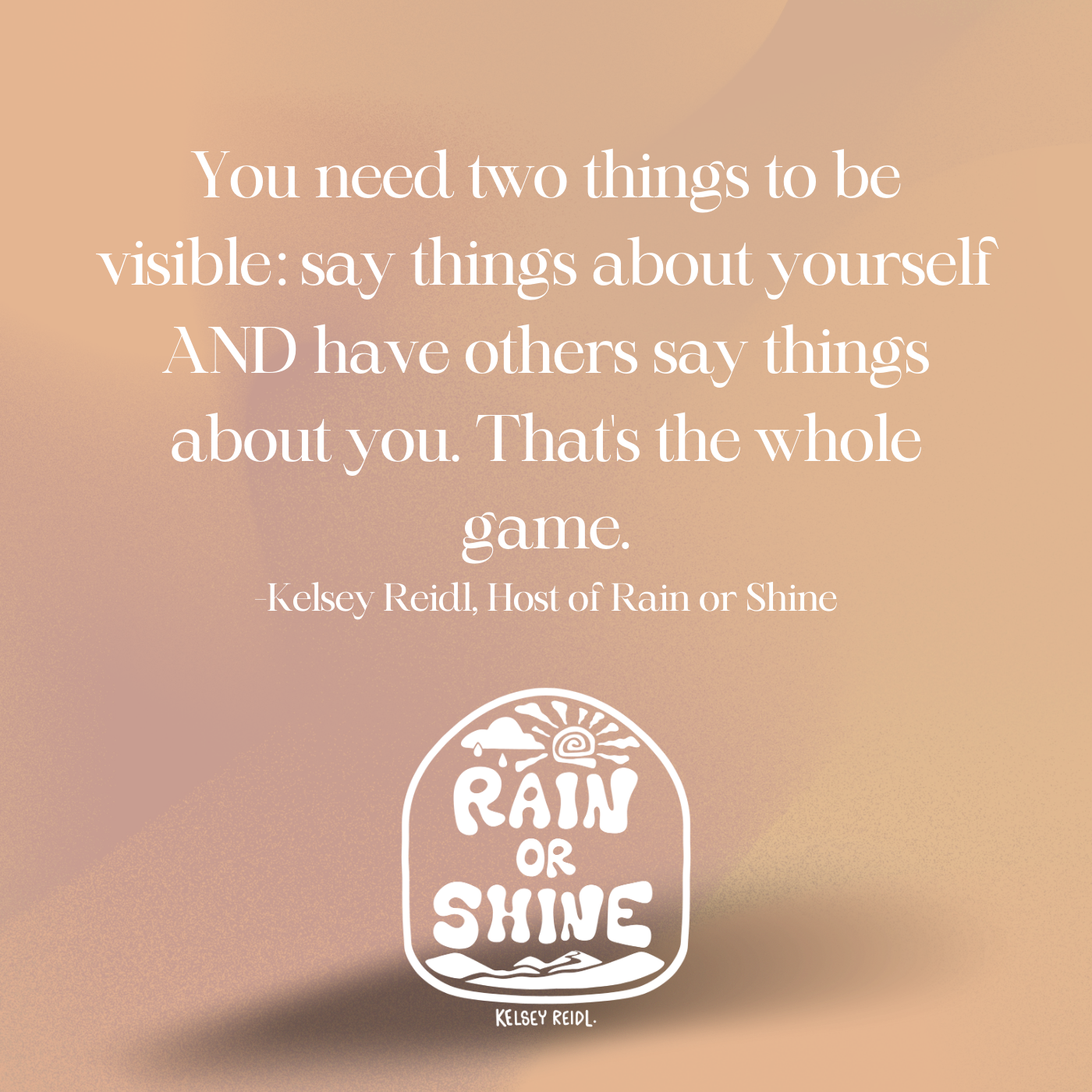
The two pillars every business needs: saying things about yourself AND having others say things about you
Practical advice for starting a business without the desperate energy
How to create a 90-day marketing plan that actually works
Key Takeaways
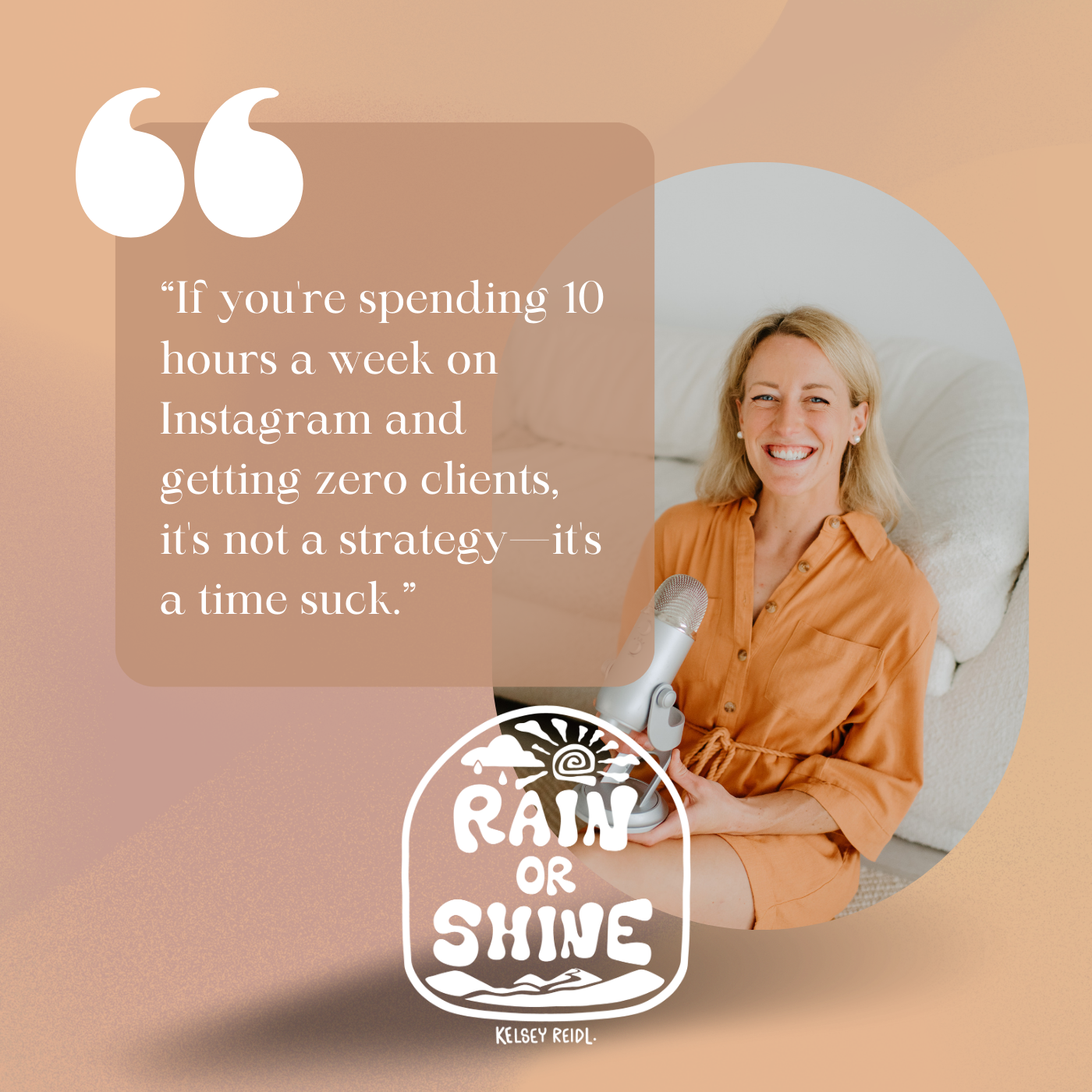
Don't assume social media is your golden ticket. If you're spending 8-10 hours a week on Instagram and getting zero clients, it's time to reassess. Marketing requires experimentation and giving strategies at least 90 days before making judgments.
Start where you have energy. Choose marketing channels based on what excites you AND where your ideal clients are paying attention. Introverts might thrive with podcasting while extroverts excel at networking events.
The Three M's of Marketing: Mission (know your goal), Mindset (play the long game and experiment), and Main Ingredients (your 3-5 core marketing channels). This framework keeps you focused and prevents burnout.
Mitigate risk when starting out. Keep a side income stream while building your business. Wake up early to give your best hours to your dream, but maintain financial security to remove desperate energy from your entrepreneurship.
Build visibility through two pillars: Say things about yourself (website, social media, networking) and have others say things about you (podcast features, Google reviews, collaborations, speaking engagements).
Memorable Quotes
"I'm being influenced in the best possible way because I want to know what somebody else's experience is. I want to be influenced so that I can make informed purchases."
"The number one question to ask is, am I having a good time? Because if the answer is no, no, no, no, no, I worry about that business."
"Business doesn't just grow by accident—it takes time and nurturing and energy and patience as well."
Resources Mentioned
Kelsey's Website: KelseyReidl.com
Kelsey's Podcast: Rain or Shine (350+ episodes featuring Canadian entrepreneurs)
WAVE Events: In-person events for female entrepreneurs in small Ontario towns
WAVE Mastermind: Weekly group for entrepreneurs earning $10K-$100K annually
Instagram/Social: @KelseyReidl
About the Guest
Kelsey Reidl is a full-stack marketing strategist, fractional CMO, and founder of WAVE Events. Based in Paris, Ontario, she helps service-based entrepreneurs build custom marketing strategies that actually work. With 15 seasons and 350+ episodes of her podcast Visionary Life, she's interviewed everyone from the founder of 1-800-GOT-JUNK to NHL players and small-town content creators. Kelsey is passionate about bringing entrepreneurs together in small towns and helping them scale to consistent six-figure years without the burnout.
-
1. CLEANED & EDITED TRANSCRIPT FOR SHOW NOTES
Becky: I am so excited to be here. As soon as I saw your Instagram, I just felt this instant connection. There's so much I relate to, especially living in a smaller town but still wanting a lot for your life and wanting to connect with people who have similar visions. Sometimes it's hard to find that in a small town—it's not impossible, but it's amazing to have communities like podcasts and groups where we can plug into people who are similar to us. So thank you for having me.
Kelsey: I love that. So tell me about your motto, "rain or shine."
Kelsey: It's actually the name of my podcast—I'm just rebranding right now. The motto is "rain or shine," and it's something I live by. Whether it relates to my exercise, if I'm going for a run at 6 AM and I wake up and it's raining, I just say "rain or shine, I committed to this." If I've scheduled in my calendar that I'm going to work on a new podcast episode, even though I don't want to, I try to say "rain or shine." It doesn't matter if I'm not always motivated—I can have the discipline to show up.
Becky: I think we all struggle with that, and it's like a muscle that we have to build up, right?
Kelsey: Exactly. So I'm not from here, but I live in Paris, Ontario. I actually grew up in a bigger town, Kitchener-Waterloo, and then I moved to Toronto for 10 years. I got the big city life and I really loved that, but when we wanted to leave Toronto, I had this feeling that I didn't want to go to a medium-sized place. I was like, I'm either big city girl—give me all the energy—or I want small town where I can go mountain biking and live in peace.
Becky: What drew you to your specific location?
Kelsey: I get very inspired in nature. Same with my husband—we love adventure, being on the water, and biking. So what drew us here was really the access to nature. I remember watching a video once of a professional mountain biker that I admire. She said, "Make sure when you buy a home that you factor in the time to trail. How long does it take you to get to the trail?" Because if it's so close, you're going to be able to mountain bike every day. But if you have to pack your bike up, go in the car, drive there, it's not as accessible. So really we were looking for a place where the access to the sports that we love was easy versus a chore.
Becky: Tell me about your journey into entrepreneurship.
Kelsey: Do you want the long version or the short version? Okay, I'll give you the long version. I always felt like I was a little bit rebellious growing up, and I had that entrepreneurial spirit. My dad was an entrepreneur, so thinking about going into a quote-unquote normal job never really sat quite right with me. But I decided to pursue that path anyway and got certified as a human resource professional. At the end of my degree, while all my colleagues were applying for jobs at big companies and they were excited, I just realized, I don't think I can do this. I'm not cut out for this.
So I ended up setting off on a multi-year adventure of traveling and working abroad, becoming a fitness instructor. I also studied at the Canadian School of Natural Nutrition and explored my hobbies, deciding to pursue wellness a little bit more. Honestly, I worked a lot of odd jobs—I taught spin classes, Orange Theory classes, I was a social media freelancer, I was a personal assistant to a woman who was quite wealthy. And I just loved that life. I knew that there was something to being multi-passionate and being able to do something different every day.
Once I graduated from the Canadian School of Natural Nutrition, I started building my nutrition business and seeing clients. What was so funny about that was that I loved talking about food and building meal plans, but what I loved more was building online funnels, creating websites, doing social media ads, coming up with marketing campaigns—all the things. A lot of my colleagues from school were saying, "Hey, can you teach me how to run online programs?" And this was like 15 years ago before there was so much learning material on these topics.
So it was just a natural evolution that I started talking a lot more about digital marketing and how to launch an online program. That led me into starting my consulting business about 10 years ago. It started more as a social media consulting agency, but now it has come full circle. I'm really doing full-stack marketing where I help business owners with absolutely everything under their marketing strategy—from how to position your business, what your elevator pitch is, all the way through to how your website shows up in search engines, how you rank on ChatGPT, and all the things.
Becky: That evolution makes so much sense. So what services do you offer now?
Kelsey: I offer two different types of services. I offer fractional CMO services where I basically step in and take a leadership role and manage the team, trying to get everybody rowing their boats the same way. Like maybe somebody has hired a social media person, a PR person, a copywriter, but there's nothing cohesive happening. So that's one of my roles.
But then the bulk of what I do is actually sitting down with small business owners and building out strategy for them and helping them to implement it. It is not a done-for-you thing. I'm more coaching and showing them how to do their own marketing plan, how to measure it, how to tweak it if necessary, and really holding them accountable to following the plan so that we can see the data to assess if this is going to help them achieve their revenue goals.
I work with people like naturopathic doctors, book publishing companies, insurance agents, social media creators who are trying to grow their business—a wide variety of service professionals.
Becky: Where should someone start with their marketing if they're feeling overwhelmed?
Kelsey: That's such a good question. First I would say, the thing we don't want to do is assume that social media is the instant ticket to success. I only say that because the amount of times that a client will come to me and say, "My Instagram is not converting." And I'll say, "How many hours are you spending on Instagram content?" And they'll say maybe like 8 or 10 hours a week. And I say, "How many clients have told you they've come from Instagram?" And the answer is often zero. That's scary. It's great to want to build an audience there, but that sometimes takes a good amount of effort and playing the long game.
When you're thinking about your strategy and where to even begin with marketing, I take a two-pronged approach. First, what excites you or where are you most attracted to paying attention to content or to marketing? If you're somebody who loves going to networking events, when you think about the last few practitioners you've hired, it's all because you met someone at a really cool mastermind or conference, or maybe a friend was raving like, "Oh my God, I worked with this person. She's amazing." All of a sudden you're like, "Okay, getting out there, making sure that I have word-of-mouth marketing." So maybe that's what you prioritize.
Maybe you are a total introvert and you're like, "Oh my God, I could never go to an event. I don't want to do stuff like that. I want to sit behind my computer, but I love talking." I'd say, "Okay great, start a podcast." It's not going to be an instant ticket to success, so you still have to look for things that get you connected to people. But start the podcast, start giving content, and look for ways to distribute it.
We're trying to make our best guess on where are you passionate enough to stay the course and see results, and where is the attention? Because if your clients or dream clients are not paying attention on Snapchat, why would you show up and create there? So it has to be a balance. And then we test—everything's an experiment with marketing. We can make our best guess, but sometimes things just take off unexpectedly. You kind of have to follow your curiosity and give everything at least 90 days before you make any snap judgments.
Becky: What are your thoughts on influencer marketing?
Kelsey: Well, I am obsessed with influencer marketing. I was actually doing a presentation the other day, and I was building out content for a group of business owners and telling them, "Attention is always shifting." And then I was also thinking, the way we're influenced is shifting. I thought about my last few purchases and I'm like, "Oh yeah, I bought Skims bras and underwear because one of my favorite YouTubers talked about them." I bought a couple other things because friends mentioned them. So I'm like, I'm being influenced in the best possible way because I want to know what somebody else's experience is, or I want to see them wearing the shirt or the necklace and stacking cute little jewelry together. I want to be influenced so that I can make informed purchases.
I think influencer marketing is incredible. I really love user-generated content. You could pay somebody $300 to make a really cool Instagram reel like, "Hey, come along with me as I go check out this event for female entrepreneurs." They do this whole promo of the event for $300. Then you have your entire marketing plan for your next event. So yeah, I just think it's the way that we want to consume content when it's done right.
And I think when we find a product we love because of influencer marketing, it's like, this is not sleazy at all. It's just exactly what I want. I don't want to be sold to by a celebrity because I'm like, you're in a different world than me. I want my friends, my peers, a bestie on the internet who has a very similar lifestyle to me. I want to be like, "Yeah, she rocks it. I'm a mom who can rock it too." There's more relatableness with influencer, especially micro-influencer marketing.
Becky: How should a business balance different marketing strategies?
Kelsey: I always go back to, what is the goal of your marketing plan right now? I think sometimes we can get caught up in, "What is the next best strategy? Should I try to go viral on this platform? Or do I need to prioritize my website?" I honestly think it changes, especially when you're a small team. You want to have one to two goals at any given time.
So if the goal is, "Well, it's winter, we really want to attract the locals," I'd be doing a whole local campaign where you're getting out to events, the founder's maybe trying to network a bit more, you're getting Google reviews, Yelp reviews, TripAdvisor reviews. Maybe you take your social media a bit more seriously and collaborate with local businesses and do like a food passport around town. So that could be the winter plan.
And then in the summer you're like, "Oh man, we know a ton of people come to Port Elgin for tourism." So we're just not going to prioritize our locals—not because we don't love them, but because there's a huge opportunity to bring content creators and they can do like, "Here's the one spot in Port Elgin you need to eat at." Maybe you focus on a couple other strategies that get tourists in the door for the day, maybe getting some articles written about you on other tourist blogs.
You could do it all at once, but for most of us, it's helpful to have a quarterly goal to go chase that goal, and then to reassess and be like, "Okay, did we do it? Yeah, cool. Keep doing it, but now let's shift focus of what we're actually prioritizing this month."
Becky: Why 90 days specifically?
Kelsey: I think a 90-day timeframe is kind of achievable for most people. Some of my clients are busy, they're a slower-moving team. So for them it would be like, let's do this for six months because I am stretched thin right now, but I still want to give it a fair chance. Other people are like, "I am on the rocket ship. You give me 30 days to do anything and I will figure it out." So it really just depends on your personality style.
Becky: Can you walk us through your framework?
Kelsey: Yeah, so I always teach a framework and I call it my Three M's of Marketing. It's Mission, Mindset, and Main Ingredients.
Mission—first you have to know what is your mission. We just chatted about that. You've got to know, what's the goal here? Why am I even doing this? Otherwise you'll quit, you'll burn out.
The second M is Mindset. Do you even have the right mindset to take on this marketing strategy? Because there are no guarantees. You're not going to become a billionaire just because you post on Instagram every day. Your email list is not going to grow to 10,000 people overnight. So we have to have this mindset of "play the long game, experiment, and just use the information that I get back to make better decisions tomorrow."
Going back to the mindset piece, I would say it's something that we have to work on every day to not take failures personally. If a marketing strategy works for, say it works for you, Becky, and I'm like, "Wow, she's got this amazing podcast. I'm going to go do that because she's getting a lot of business from it." And so I go do the podcast and maybe I do it for six months and I'm like, "This has given me nothing." It's not because I did it wrong. Maybe I just need the mindset of, "Okay, well maybe I need to change the format, so maybe that one didn't hit with my audience." Or, "You know what, I've just been in a bad headspace. Every time I get down to record, I am just miserable and I don't like this. I think I need to do something else."
Maybe you have a short-term mindset where you release three episodes and you expect to have clients knocking at your door. It's like, oh, maybe I need to do this a little longer because there's literally tens of thousands of podcasts that people can choose from. So yeah, it's always just checking in with yourself, being like, have I given this a fair chance? Am I holding myself back from success? Can I be a bit more stoic in this process? Because business doesn't just grow by accident—it takes time and nurturing and energy and patience as well.
The number one question to ask is, am I having a good time? I always get my clients to do monthly reporting, and it's not just about the numbers. It's not just how many followers you have or how many website views you get. It's also about, did I enjoy creating content? Did I enjoy interviewing people on my podcast? Because if the answer is no, no, no, no, no, I worry about that business, and I want to try to protect you before you just shut it down and go back to your job.
And then the third M is Main Ingredients. So what are the three to five marketing channels that I will prioritize? Maybe you decide for the first 90 days to test out one networking event a month, posting on Instagram three times a week, posting on Facebook three times a week, building your email list with an opt-in—so like "Five restaurants that serve gluten-free food in Port Elgin" or whatever the case is—and maybe your fifth strategy is asking for referrals. So those are just the main ingredients. Those are what you test. And they're always changing, right? It's like tweaking a recipe each time you make it to make it better and to add the spices you like. Really the Three M's are just to get you on track with that very first marketing plan.
Becky: What about email marketing? Is it still necessary?
Kelsey: I am not very—I would never tell anyone they have to do anything. Because if you're not a consumer of email, if you really just don't see the benefit because you have another line of communication with your clients like a WhatsApp group or a cool Facebook group, or maybe you have a text message marketing list, then maybe email marketing's not the thing. I know there are people out there saying Pinterest is the way to go, or whatever, and it's like, no, it's not. You've got to find the way that works for you.
I do think though, there are two things you need to think about, especially in this day and age of wanting to appear in AI search engines, be discovered, and make sure you are top of mind.
Number one, you need to say things about yourself on the internet and in person. So you need to say stuff on a website. You should say stuff on one or two social media platforms because you get to say stuff about yourself. You should go to a networking event and introduce yourself to people. So that's pillar one: say things about yourself.
And number two is other people should be saying stuff about you. So right now you're actually featuring me on your podcast, so you're kind of validating that I am a real person and I don't just talk about myself all the time. Google reviews—a client just left me a Google review yesterday. That's someone else saying something about me. If someone wants to feature me in a blog post or have me speak at their event, they're basically bringing me to their group.
So those are the two things I would think about and just find whatever combo of those two pillars. Have a website because people do want to search for you. ChatGPT loves that. Google loves that. But also where are you building real relationships, partnerships, collaboration opportunities? Are you networking with other business owners in your small town online? Because this is not just you sitting in an office trying to do everything yourself. It should be a journey of building as many relationships as possible, because that person will win in the end.
Becky: Tell us how people can work with you.
Kelsey: Yeah, so I offer one-on-one coaching for the person who's stuck, they're tired of online courses, they feel overwhelmed, they're just not seeing results and they want more clients. I help sit down with you over three months or six months to build a custom marketing strategy, and I actually work with you on a project management software to implement everything.
I also have events that I run in small towns. We purposely do not host the events in Toronto because we want there to be easy parking. We want people to feel like, "Oh yeah, I've always wanted to go to that cute, charming town." So we have one in Elora coming up at the end of October. Our next one will be in Paris next year. So you can find those.
And if you are not able to get to the live events, we also have a mastermind group that meets every Wednesday. It's such a wonderful group—people between $10,000 in annual revenue and $100,000 who are looking to scale to that consistent six-figure years.
Becky: Tell us more about the WAVE events.
Kelsey: Yeah, so we have events twice a year. They're called WAVE. WAVE stands for Wealth, Ambition, Vision, and Energy. These are four things that we all want more of in life, and that's what the content of the group is about.
We have an event coming up at the Elora Mill on Thursday, October 30th. There are 60 female entrepreneurs coming. We have four incredible speakers who have had highs and lows on their journey. We have a country music artist who's going to be performing, but also sharing the business of creativity. So yeah, it's a really fun day.
You'll spend from 11 AM until 4 PM. We will curate little networking groups so that you actually get to meet people—guest speakers, panel discussions. We have little surprise activations to activate your creativity and just to get back in that soulful, playful space. Obviously a fully catered lunch by the Elora Mill, so appetizer, dessert, main meal, coffee, tea, right on the Elora Gorge. So it's beautiful. If anyone wants to come, there's about seven tickets left, so I hope you can snag one. We'd love to see you there.
Becky: And tell us about your podcast, Visionary Life.
Kelsey: Absolutely. So yeah, back in 2017, early days, I started a podcast because I asked a friend, "Hey, should I start a podcast or do a YouTube channel?" And she's like, "I don't see you on YouTube." I was like, "Thanks." She meant it in the most genuine way. She's like, "You'll love talking. I don't think you'll be able to keep up with YouTube and vlogging yourself."
So I started a podcast, I called it Visionary Life, and we've recorded 15 seasons over the last eight years. There are about 350 episodes with Canadian entrepreneurs from all different facets. We've had the founder of 1-800-GOT-JUNK on the show. We've had NHL hockey players from the Toronto Maple Leafs. We've had people just like us who are small-town content creators. Yeah, we just interview some epic visionary humans and share their story—the highs, the lows, the in-betweens. So yeah, you can tune in. Season 16 will be starting very soon, but you can just search Visionary Life on any podcast app of choice.
Becky: What advice would you give someone who wants to start a business?
Kelsey: Oh my goodness. Such a good question to end off on, Becky. I feel like there's a lot of people who will tell you to "leap and the net will appear." But I find in reality, that's just not how it always works. And I like to bring a real perspective to what it's like to start a business. It's a rocky road, it's a rollercoaster. There are ups and downs.
So I would say do what you can to mitigate risk and take the desperate energy away. Because if you start day one and you're like, "I need to make $10,000 a month," there's just this heavy energy. But if you're able to—similar to how I did—I was still teaching fitness classes, I took on a personal assistant client, a social media contract so that I could meet my baseline needs. But I woke up every day at 6 AM and I tried to give my best hours to working on the business, to planting seeds, to figuring out what I was going to do.
So I would do that three to four hours a day. Then I would go make money in other ways, and that really allowed me to just not feel so much pressure, to not feel like if it didn't work in six months or 12 months that I had to go quit and go back to a job-job, which I didn't want to do. So I just allowed myself that breathing space by making sure I was bringing in X amount of money per month, which I knew I needed to feel secure. And it allowed me to take a couple years to just grow it in the timing that it wanted.
Becky: Thank you. I love what you're doing with the show. You're a wonderful interviewer. I'll be binging all the episodes for this season. It would be amazing to meet you in real life. We'll definitely drop those dates soon for spring 2026. Thanks, Becky!
Book Your Free Marketing Strategy Call
Your business deserves to be found—both on Google and ChatGPT.
If you're a solopreneur, author, or thought leader wondering why your marketing isn't translating to consistent revenue, the problem usually isn't what you think.
After 8+ years of working with ambitious entrepreneurs, I've discovered something crucial: most marketing challenges aren't about needing more tactics—they're about solving the wrong problem.
Here's What We'll Uncover Together:
✓ The Real Constraint blocking your growth (it's rarely what you think)
✓ Your SEO Opportunity to rank on Google for what matters
✓ Your AI Visibility Gap and how to show up when prospects ask ChatGPT
✓ Your Lead Generation Blind Spots and where you're losing potential clients
✓ Your Custom Funnel Analysis showing exactly where the leaks are
Book now!
The Potential Return: A clear path to $10K-$50K+ in new revenue
I work with business owners who are done guessing and ready for a marketing strategy built on what actually works—not marketing myths.