399 How to Train Your Voice for Confidence: Vocal Performance Coach Dr. Shannon Holmes on Presence, Nerves, and Authentic Speaking
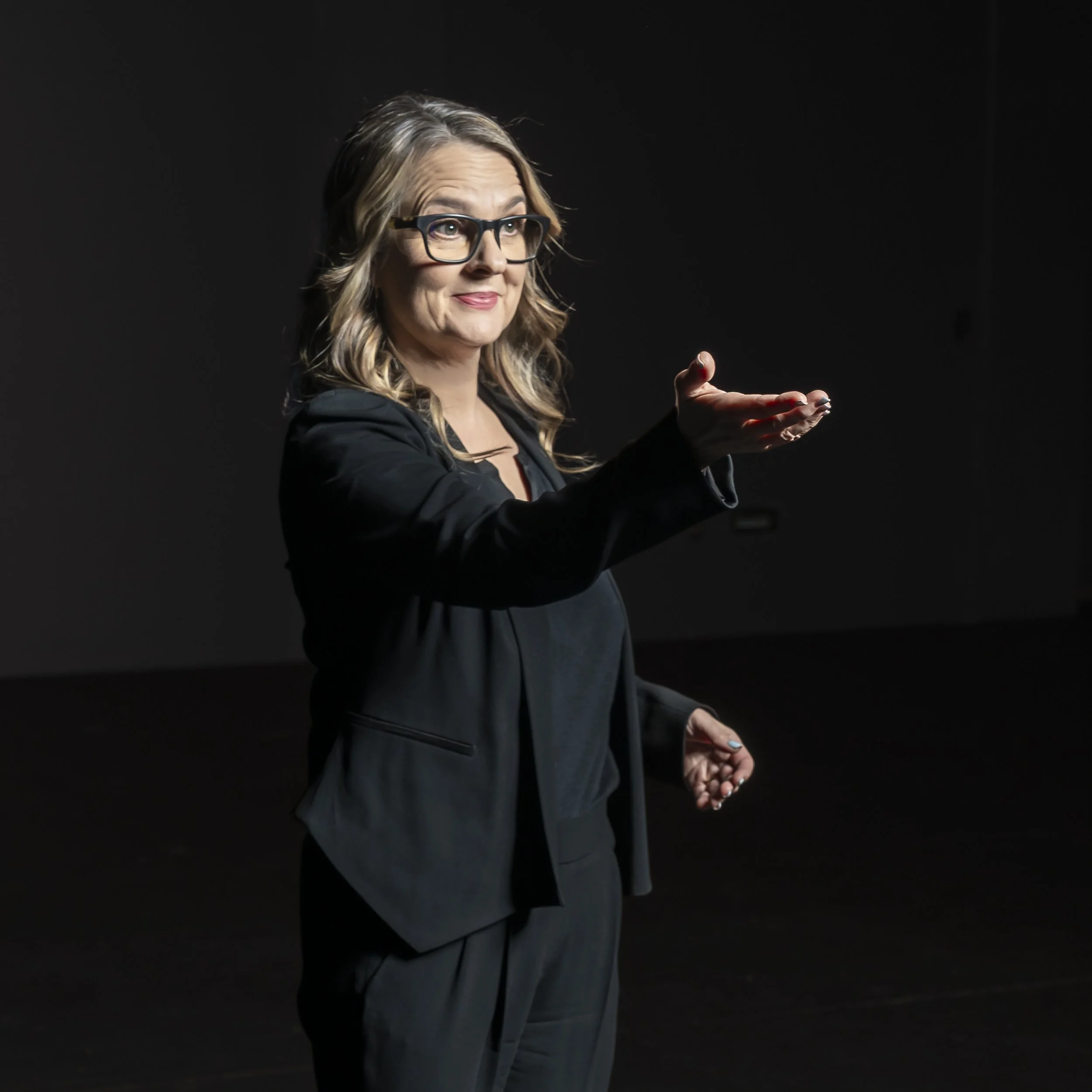
Your Voice Is Giving You Away: The Science of Vocal Presence with Dr. Shannon Holmes
Episode 399: Rain or Shine Podcast
Guest: Dr. Shannon Holmes, Vocal Performance Coach, Professor, and Researcher with a PhD
How to Train Your Voice for Confidence: Vocal Performance Coach Dr. Shannon Holmes on Presence, Nerves, and Authentic Speaking
Episode 399: Rain or Shine Podcast
Guest: Dr. Shannon Holmes, Vocal Performance Coach, Professor, and Researcher with a PhD
Quick Summary
Vocal performance coach and PhD, Dr. Shannon Holmes, joins Kelsey to reveal how your voice is constantly broadcasting signals about your confidence, credibility, and authority — whether you realize it or not. From the science of human voice perception to practical body-based techniques for speaking with presence, this episode is a masterclass in one of the most underrated professional skills. Plus, Dr. Shannon shares her inspiring personal story of earning a PhD at 50 while raising six children.
In This Episode
Dr. Shannon's journey: having children young, hiding it professionally, and eventually owning her path
Going back for a master's degree in her early forties and a PhD at 50 — from Montreal, studying in the UK
Advice for working moms on presence, letting go, and asking for help
The science of human voice perception — how quickly we judge others' voices (and they judge ours)
Natural voice vs. habitual voice: why "I'm just monotone" is a myth
What vocal masks are and how we unconsciously use them
The body-voice connection and why it's the foundation of all vocal work
Pre-performance rituals: how to take up space, breathe in the room, and walk in with authority
How to train your voice in everyday low-stakes moments
Key Takeaways
It's never too late. Dr. Shannon earned her PhD at 50 with six children and a transatlantic commute. The "expiry date" on your dreams is one you invented.
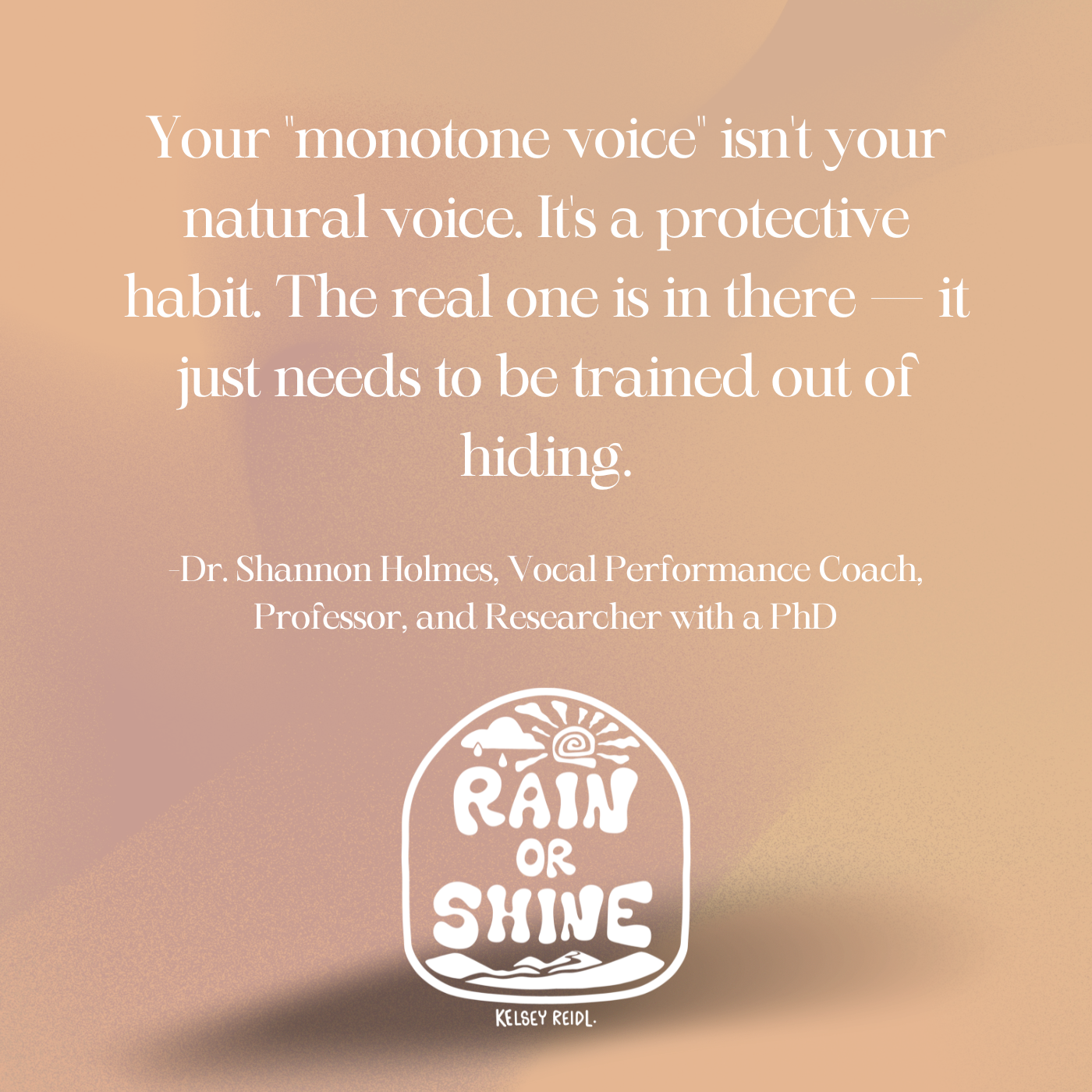
Your habitual voice is not your natural voice. The monotone or quiet voice you use under pressure is a protective habit — not who you really are.
Body first, breath second, voice third. If your body is tense, your breath is restricted. If your breath is restricted, your voice can't be free. Start there.
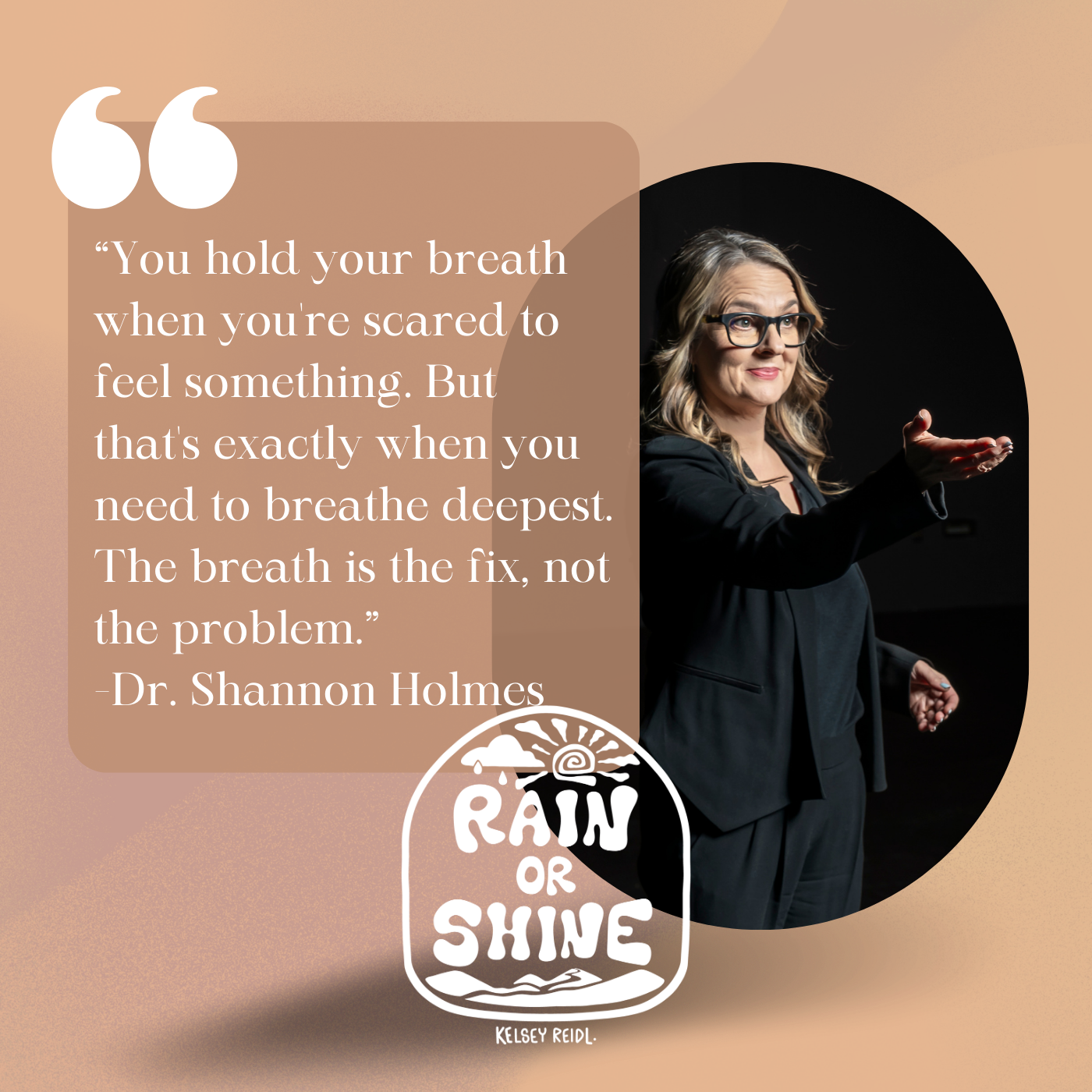
Stop holding your breath before you speak. We hold our breath to avoid feeling fear — but that's exactly when we need to breathe deepest. Breath signals safety to your nervous system.
Leave the voice to chance and you've already lost the room. All the slide prep in the world won't save you if you haven't practiced how you'll actually deliver the content.
Memorable Quotes
"If the body isn't free, the breath isn't free — and if the breath isn't free, the voice isn't free." — Dr. Shannon Holmes
"People confuse their habitual voice for their natural voice. That flat, monotone delivery under pressure? That's not who you are. That's a habit you've built to protect yourself." — Dr. Shannon Holmes
"You can have everything — just not all at the same time. I really had to learn that." — Dr. Shannon Holmes
Resources Mentioned
Dr. Shannon's website: www.shannonholmes.ca
Dr. Shannon on Instagram:@dr.shannonholmesdovoice
Kelsey's website: www.KelseyReidl.com
Kelsey's instagram: @KelseyReidl
Wave Event — Friday, April 17th (Rain or Shine community event)
Special offer:Mention "Rain or Shine" in your application on Dr. Shannon's website for a special listener rate
About the Guest
Dr. Shannon Holmes is a vocal performance coach, professor, and researcher with a PhD earned at 50, specializing in the intersection of voice, body, and authentic expression. With a background in opera and theater performance, she now works with executives, entrepreneurs, and academics to unlock their natural vocal authority. She is a speaker at the Rain or Shine Wave event on April 17th.
-
Kelsey: Dr. Shannon Holmes, welcome to the Rain or Shine podcast. I'm so excited to feature you today — not only because you're an amazing vocal performance coach with so many accolades, but also because you are one of our speakers at the upcoming Wave event on Friday, April 17th. I thought this would be a great chance for me to ask you some of the burning questions I've wanted to ask for many months, and for our listeners to get a little taste of what you'll be speaking about at the event. Thank you so much for being here.
Dr. Shannon: Thank you so much, Kelsey. I'm really pleased to be here.
Kelsey: Let's kick off with motherhood, chasing your dreams later in life, raising kids, and not ignoring your passions. Can you give us a snapshot of your journey? You have such an interesting story — six children, a master's degree in your early forties, and a PhD at 50. So many of us today are afraid to make changes after our twenties, worried it's too late at 31 or 40. Can you bring us back to that story?
Dr. Shannon: Absolutely. My motherhood journey started earlier than many of my friends and colleagues. I had my first child at 23 while I was in my undergrad program, and in the circles I was in — seriously pursuing a career in theater and opera — that was early and honestly frowned upon. At the time, you either had a career or you had children. I always knew I wanted both, and I always knew I wanted a large family.
In the beginning, I went to great lengths to hide the fact that I had children from the people I was working with professionally in theater and opera. After maybe three kids, I hit a turning point. I had some maturity by then, and I started living my truth — being more open as a working professional performer who also had children.
It was around that time that I was also doing a lot of teaching and coaching, and I wanted to pursue that more seriously. Heading into my forties — I had my last child at 40 — I decided to go back and get a master's degree. I found it so fulfilling that I thought, I'm going all the way. I'm getting a PhD.
Along the way there was a lot of pushback from family and friends — a lot of "Are you crazy? What are you doing? Why would you do this at this age?" But honestly, I was following my bliss. I was following my true curiosity, and I did it. It was not easy. That whole idea of "you can have everything, but not all at the same time" — I really had to learn that. My PhD was done in the UK, so I was flying back and forth from Montreal to England to study. My partner held the fort at home, and my kids were genuinely flexible and supportive. I feel like we all did that PhD together. It was a long, hard road, and I don't regret a moment of it.
Kelsey: That's so meaningful to hear, because I think we all have our own version of this — whether in our twenties, thirties, forties, or fifties — where there's a yearning or a calling that's been sitting with us for months, years, or even decades. And it's easy to let the noise of the world or the opinions of others derail us from chasing something that was truly placed on our hearts. Hearing your story is such a good reminder to tune out the chatter and come back inward and ask: what do I actually want? And what does "too late" even mean?
Dr. Shannon: Exactly. Looking back, even in my late twenties and at 30, in the opera world especially, there's an expiry date. If you haven't achieved certain things by a certain age, the thinking was: you're done. That belief lived in me for a long time. And I still hear it from my students — 25-year-olds saying, "I'm so old." It is truly just a number. As clichéd as that sounds, you can make whatever decisions you want to make at any age.
Kelsey: Before we shift into your expertise as a vocal performance coach, do you have any advice for the working mama who's juggling a lot right now — kids, professional ambitions, all of it?
Dr. Shannon: When you're with your kids, really be with them. I'm so grateful that when my children were small, cell phones didn't exist. I could actually turn off and just be present. Another thing that was genuinely hard for me in my early parenting years: ask for help. I wanted to do everything on my own, and as I took on more — more children, going back to school — I realized that was unsustainable. Take the help. Say yes to the help. And be okay with things not being exactly how you want them at home.
I'm not talking about the values you instill in your children. I mean things like how the laundry's folded — let it go. For me, there was one thing I held onto: making the bed. It takes two seconds, and I could look at it and feel a small sense of accomplishment. That was my one point of control. Everything else, I learned to release.
Kelsey: Okay, so for someone who has never really considered how their voice reveals things about them — can you give us an overview of why the voice is such an important topic?
Dr. Shannon: In very simple terms — think about calling a friend and asking how they're doing. They say "fine" in a flat, held-back way, and you know immediately that something's wrong. That's the voice at work. There's also research called human voice perception, which tells us that within roughly a quarter of a second, we make judgements about people based on the sound of their voice — their credibility, their authority, whether they're a threat.
When we're not able to access our voice fully, it gets in the way of how others perceive us. And what prevents us from accessing our voice? Usually nerves and habits we've placed on ourselves — habits we developed to protect ourselves, because our voices are vulnerable. We know people are judging them, even unconsciously. So we fall into patterns. Think of a group of teenagers — they all start speaking the same way, and that becomes just how they talk.
We all also have what I call vocal masks — different ways of speaking in different situations. There's the voice I use with my dog, the voice I use when I call the bank, the voice I use with my best friends. These are all me, but I unconsciously flip between them. When we want to show up fully as ourselves, we need to be careful that these habits aren't taking over. Everyone talks about finding your authentic voice, but no one really breaks down what that actually means. That's one of the things I really explored during my PhD.
Kelsey: Is vocal improvement a learnable skill? If someone is monotone, or feels they don't project well, or has been told they don't have "the voice" for something — can that change?
Dr. Shannon: One hundred percent. There's an important distinction between your natural voice and your habitual voice, and people confuse them. Someone who says "I'm just monotone — that's how I speak" — I guarantee that if they were telling a great story to their closest friends, they wouldn't be monotone. There would be inflection. People confuse their habitual patterns for their natural voice.
Those habits come on especially strongly when we're under pressure — on stage, on a mic, in the spotlight. That's when we retreat into those protective patterns and call it our "natural voice." Similarly, people come to me having been told they need to project more. Yes, there are technical things we can work on — but you also have to acknowledge your own capability. If someone jumped out and surprised you, you wouldn't stop to think about breath technique before reacting. Your body already knows what to do.
It's like peeling an onion — taking back the layers of habit that are inhibiting your real, authentic voice. And it absolutely is learnable. I ran my first marathon at 40, and I was never an athletic person. You can train your body, and you can train your voice. Same principle.
Kelsey: So where do we start if we want to improve?
Dr. Shannon: The first place I start with anyone is this: the body and voice are one. They don't operate separately. Whatever is happening in the body will manifest in the voice. Nervousness, tension, anxiety — they all live in the body. So many people think they just need to get rid of their nerves, but we don't want to get rid of them. Athletes get amped up before a game. That flutter, that elevated heart rate — those are signals that it's go time. I have a little vocal math I use: if the body isn't free, the breath isn't free, and if the breath isn't free, the voice isn't free.
So we start with the body. Where are you holding tension? How does that affect your breath? Because that's actually how the voice is produced — air comes in, the diaphragm moves, the air travels back up through the vocal folds, they vibrate, and sound resonates through the body. Most people think their voice lives in their throat, but it's a whole-body instrument. When people say someone is "grounded" or "embodied" as a speaker, those are bodily things. The voice can't be separated from that.
Kelsey: What about the moments right before speaking — on stage, in a meeting, before a pitch? What can someone do in that one minute to get into their body?
Dr. Shannon: I call it taking up space. Whatever you're about to do is bigger than everyday life. It's extraordinary. So physically take up space — arms out to the side, expand rather than collapse. When you breathe in, don't hunch. Take in a full breath on a slow count in and a longer exhale out, while feeling expansion in the body — not collapse.
The other thing opera singers do when they walk into a new space is what I call "breathing in the room." You orient to the space. You feel your energy in it. Even if it's 10 seconds, you're not walking out onto a stage or popping up on Zoom and then trying to unfurl. You've done that work already. People are already making judgements the moment you appear. Walk in — or appear on screen — with authority. Feel your feet on the floor. Breathe into the space.
Here's the other key insight: we hold our breath when we don't want to feel things. When we're nervous, we hold our breath to stop feeling fear. And that's our first mistake. We have to breathe through it, breathe into it. That sends a signal to your nervous system: you're okay. You're all right.
Kelsey: So the preparation isn't just about the slides or the outfit — it's also about having a pre-stage ritual?
Dr. Shannon: Absolutely. It drives me a little bit crazy that people put so much energy into everything else and leave the voice to chance. We think we should just be able to do it. And yes, we're all capable — but that doesn't mean the habits we've built up won't get in the way. Nerves will come. The key is learning to speak with authority despite all of that. And those are learnable, trainable things.
Find the low-stakes moments to practice. Speaking up in a meeting. Being intentional about how you communicate with your doctor. Those everyday moments are where you build the skill before the big pitch.
Kelsey: So many good tips. Dr. Shannon, for anyone who can't make it to the Wave event on April 17th, where can people connect with you?
Dr. Shannon: You can visit my website at shannonholmes.ca — Holmes like Sherlock. If you're interested in working with me, there's an application there. And for Kelsey's listeners, I'm happy to offer a special rate — just mention Rain or Shine in your application. You can also follow me on Instagram at Dr. Shannon Homes Do Voice. I've been finding it a fantastic platform for connecting with people across so many different disciplines and interests.
Kelsey: We'll link both in the show notes. Dr. Shannon, thank you so much for being on the podcast. I think all of us can walk away and implement something right away. Thank you, and we wish you all the best!
Dr. Shannon: My pleasure. Thanks, Kelsey.

Book Your Free Marketing Strategy Call
Your business deserves to be found—both on Google and ChatGPT.
If you're a solopreneur, author, or thought leader wondering why your marketing isn't translating to consistent revenue, the problem usually isn't what you think.
After 8+ years of working with ambitious entrepreneurs, I've discovered something crucial: most marketing challenges aren't about needing more tactics—they're about solving the wrong problem.
Here's What We'll Uncover Together:
✓ The Real Constraint blocking your growth (it's rarely what you think)
✓ Your SEO Opportunity to rank on Google for what matters
✓ Your AI Visibility Gap and how to show up when prospects ask ChatGPT
✓ Your Lead Generation Blind Spots and where you're losing potential clients
✓ Your Custom Funnel Analysis showing exactly where the leaks are
Book now!
The Potential Return: A clear path to $10K-$50K+ in new revenue
I work with business owners who are done guessing and ready for a marketing strategy built on what actually works—not marketing myths.