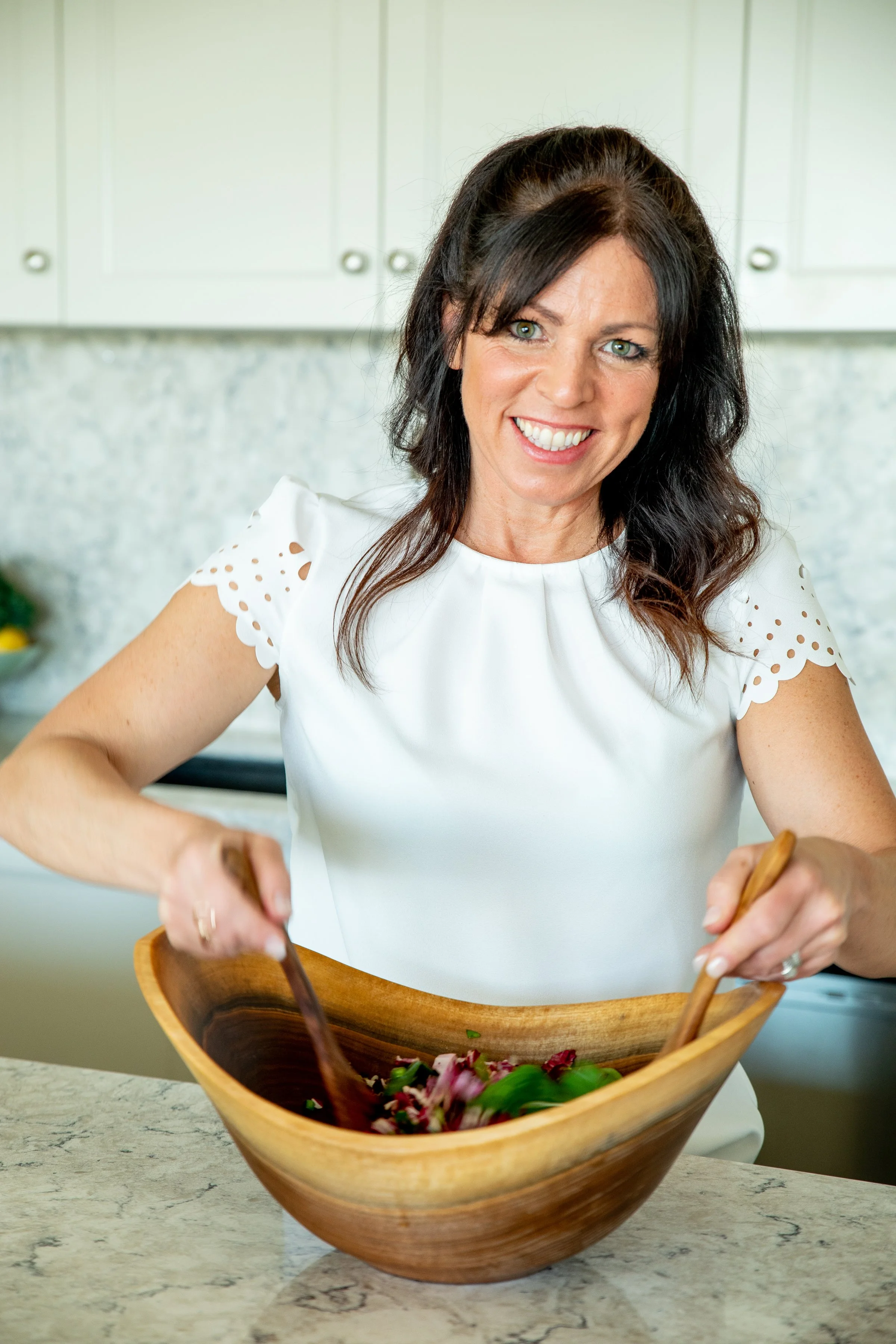
Meet Amy Jones!
A Certified Functional Nutrition Practitioner, a Certified ADHD Life Coach and a Certified Ontario Teacher, and she's partway through an MSc in Applied Neuroscience at King's College London.
Welcome to our Canadian Business Owner Spotlight Series hosted by me… Kelsey Reidl (Business & Marketing Consultant).
In this series, I'll be catching up with the most talented, generous & inspiring entrepreneurs and small business owners in Canada & beyond.
Enjoy learning more about these wonderful humans, and give them a ‘follow’ or get in touch in order to collaborate with them + work with them.
-Kelsey
The TL;DR for Amy Jones of The Amy Jones Nutrition
Amy Jones is a Certified Functional Nutrition Practitioner, a Certified ADHD Life Coach and a Certified Ontario Teacher, and she's partway through an MSc in Applied Neuroscience at King's College London. She taught for close to twenty years before opening Amy Jones Nutrition, a virtual practice working with neurodivergent adults, parents and teens. Her work is about why eating gets hard on days when there's nothing left for planning or cooking, and her Accessible Nourishment Framework was built for those hard days, not the easy ones. She teaches Aging and Geriatrics Nutrition through CSNN and she's a regular podcast, summit and expo guest speaker. In December she’s speaking at the ADHD2026 International Conference in Baltimore.

Okay, let’s get to know Amy!
Name
Amy Jones
Profession / Title
Certified Functional Nutrition Practitioner and Certified ADHD Life Coach
Business Name
Amy Jones Nutrition
Industry / Niche
Functional nutrition and ADHD coaching for neurodivergent adults, parents, and teens
My Business Was Founded In
2023
Current Location
Toronto, Ontario, Canada
3 words you would use to describe yourself…
Resilient.
Creative.
Passionate advocate.
Tell us more about your business
I work with adults and teens who know exactly what they should be eating and still can't make it happen at the end of a hard day, and my job is to work out why, which is almost never a lack of information. Most of the people who come to me have already seen a nutritionist and already tried the meal plan that worked for two weeks and then stopped, so I don't start with what to eat; I start with where it breaks down. Usually there's no food in the house that's ready to eat by the time the cooking has to happen, or there's a medication nobody has ever explained to them, since stimulants raise dopamine and noradrenaline and those same signals suppress appetite, so we eat almost nothing while it's working and then can't stop once it wears off.
My week is one-to-one sessions, writing the programs and handouts my clients work from, and teaching an Aging and Geriatrics Nutrition course through CSNN. I'm also building a training program for other nutritionists on the implementation side of this, which is the part school doesn't teach. People find me through podcasts and ADHD conferences and Instagram, and most of them get in touch because it was the first time anybody had answered why food gets hard, instead of telling them to plan better.
In one or two sentences, what specific problem does your business solve for your clients?
My clients already know what they should be eating, so the problem isn’t information. What stops them is everything between knowing it and doing it, which is the planning, the shopping, the deciding and the cooking, and all of that takes energy and attention that have usually run out by dinner time, and that’s what I work on.
Recent milestone you've celebrated in your business
I was selected to present at the ADHD2026 International Conference in Baltimore this December, on redesigning food systems for low-capacity days. The clinicians and researchers I've been learning from for years present at that conference, and being on the program with them is the thing I most wanted this year.
What is a recent investment you’ve made in your business
Business coaching, and I’ve worked with a few different coaches over the years, which is its own kind of education. It took me a while to work out how I work best and who I work best with, and the coaching that’s made the difference has been with someone who takes real time to understand what I’m actually trying to do, and then helps me say it clearly.
A lot of that work has been about relationships rather than marketing. Not only relationships inside nutrition, and not only with people working in my exact area, but with other practitioners and other business owners generally, which means showing up in person. I go to East End Connected, a networking group for female entrepreneurs in the east end of Toronto, and I get to The Forum whenever I can, which runs online on Wednesdays with entrepreneurs from across Canada.
Every one of those rooms makes you say out loud what you do. Someone turns to you and says, “Okay, your turn, what do you do?” and oof, that’s a lot to answer in 30 seconds, and answering it over and over is what sharpened it. The reason I count the coaching as the investment rather than the networking itself is that a coach who actually sees you will point you toward the rooms that are right for you, instead of handing you a prescribed program or course or outline to follow. That kind of template has never worked for me. It might work beautifully for someone else.
What changed after that investment? Why do you see it as an investment, not an expense?
What changed is that I remembered to step into my own strengths. I taught for 20 years, so at some point the question became, why am I not talking to people? I talked for a living. I’m good at talking. I have ADHD, and I love talking. None of that was new information about me, but it took a coach who was aligned with me, and who could see those strengths, to get me to build the business around them instead of around whatever I thought a nutrition business was supposed to look like.
After that it was confidence and reps. The more I spoke, the easier speaking got, and the more it sounded like me. Then I applied to present at the International ADHD Conference in Baltimore this December, and I got it. That’s an enormous investment on its own. I’m paying for the flight and the hotel and the time away, and I don’t get paid to speak there. It’s worth every bit of it, because of the visibility and because of who’s in that room. My people are in that room. Colleagues, peers, people doing work right next to mine, and yes, future clients, and it’s where I get to stand up as someone who who’s an expert in my field.
What would you tell a new entrepreneur who's considering investing in the same thing, but is hesitant?
Take your time, and be scrutinous. Before you hand anybody money, sit with a set of questions and answer them honestly. Is this person aligned with me? Are they asking me to twist myself into their program? Do I have to follow exactly what they tell me, or is there wiggle room for how I actually work? Is this coach going to have time for me, do I get one-on-one, and do I get to ask questions in between? Do they see me for who I am, and is the support personalized, or is it the same thing everybody else in there is getting?
A good coach usually does have resources laid out in some kind of program, and that’s fine, because the structure has to come from somewhere. What you’re looking for is what sits alongside it, which is a weekly call, and feedback on your business specifically and on you, and the coach who says send me your landing page and I’ll audit it this month and tell you what I’d change. The reason I’m firm about this is that a lot of us, and I’m speaking for myself here, have twisted ourselves into someone else’s idea of how a business should run. I live in a neurodivergent brain, and the way I work is not the way everybody else works, so when I force myself into a system built for a different brain, it doesn’t support me, and the work that comes out of it doesn’t speak to the people I actually want to work with. It was wrong from the start, and no amount of effort fixes that.
Now for some fun stuff!
Always…
Always eat in the morning, even when I’m not hungry, and it doesn’t have to be a meal, a few nuts and seeds with a spoonful of Greek yogurt is enough. I’m at the gym first thing, so I need fuel before I ask my body to work. If I don’t do this, I notice my blood sugar dropping several times through the afternoon, and then I really notice my hunger, and it tends to come back all at once, usually late in the afternoon or at the end of the day.
Never…
Never build a system for a good week. When I'm building something for a client, or when I'm standing in my own kitchen working out the week for my own kids, I'm looking at the days where it's going to be a rush, and that's what we build for. What have I got at my fingertips, here and there and everywhere? We're never idealistically planning a meal plan; that's not a thing.
Advice for other entrepreneurs, who are slightly less far along…
So much of what’s out there is about what we think we’re supposed to be doing, and when you’re new that noise is at its loudest. None of it will work for you if it doesn’t feel right, and the distinction I keep coming back to is between something that’s hard and something that’s wrong. Hard is fine, and hard usually means it’s a webinar I’ve never run before or a pitch I’ve never written, and I’ve got a clear purpose for doing it anyway.
Wrong feels like I should be doing this because everybody else is, and that’s the one to label as a red flag. We do have to market ourselves, and I’m not pretending otherwise, but there’s room inside that to do it in a way that fits you. I still have to check myself on this, and I’m not overly seasoned here, but asking which one it is, hard or wrong, has saved me a lot of hours. Keeping up with what everybody else is doing all the time isn’t going to work, no matter how hard we try.
What is a tool, resource, podcast, book or person you’ve invested in that’s added value to your entrepreneurial journey
Stephanie Long, Ashley Goes and Lyndsey Thomas are business coaches I’ve worked with, and each of them has shaped how I run this practice. Heidi Fishbein is the director of the iACT Center, where I trained as an ADHD life coach, and she’s my own coach and a mentor. Jeff Copper at DIG Coaching Practice is a mentor too, and I trained in his paradigm, cognitive ergonomics, which is the practice of looking at the environment around a person rather than at the person, and asking what in that environment is standing between them and the thing they’re trying to do.
Once you start looking that way, you stop asking why someone didn’t follow through and you start asking what made following through so expensive. That’s the lens I bring to every client now. What’s hard about this, specifically, and how do we make it easier? It’s changed how I work as both a nutritionist and a coach.
Favourite way to wind down after a long workweek
Saturday night at home with my husband and my boys, either movie night or Ted Lasso night, and takeout so that nobody's cooking.
Before starting my workday, I make sure to…
Get to the gym, since that's how my brain needs to start the day, and have a good giggle with my gym friends, who are some of my best friends in the whole world.
Best part of my work is…
The best part is the building. I’m a functional nutrition practitioner and a coach, and those are two different jobs. The nutrition part I can answer, meaning what the body needs, what the bloodwork is showing, and where the protein and the fibre have to come from. The coaching part works the other way, since I am not the person who has all the answers. What I do as a coach is we figure those out together, because it’s unique to them, and my client is the only one who knows their own day and their own kitchen and what they’ll actually eat on a Wednesday.
I’m not sitting there with a plan in my head waiting to hand it over. We talk it through and work it out, and when we figure out something that works for their individual needs, you can hear it, because a client will say “Oh my gosh, I never thought of it that way!” or “Wow, I had no idea!”, and those are pretty amazing moments. Another part of this is when a client trusts me and trusts our work enough to recommend me to someone else, and that person books a discovery call and tells me their good friend or their family member sent them to me. What an honour to be trusted like that.
Last vacation you took (and where did you go)
Prince Edward Island. We drove the whole way from Toronto, and spent a couple of weeks with the Jones family eating lobster and crab and going for long walks along the shore, which was absolutely beautiful.